

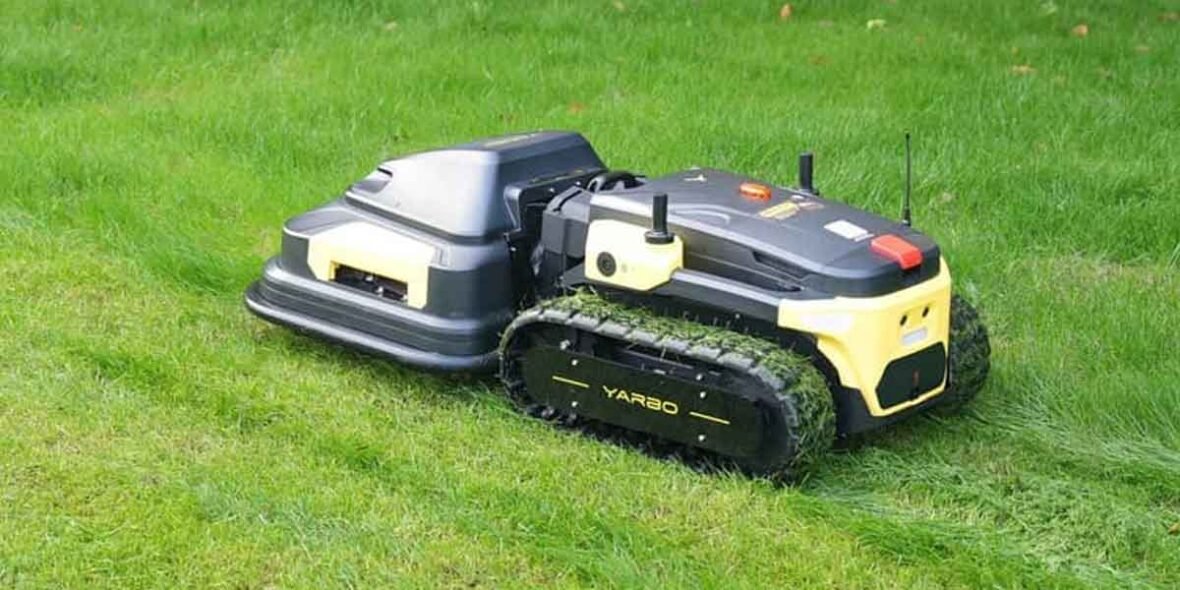
Robot lawn mowers are often presented as a cleaner alternative to traditional petrol-powered mowing, and in some respects they are. They run on electricity, operate quietly and can remove the need for repeated use of a combustion engine on the lawn. Yet calling them “green” without qualification misses an important part of the picture.
Like most modern technology, robot mowers come with environmental costs of their own. Their batteries have to be manufactured, electronic components eventually become waste, and frequent automated cutting can influence the ecology of a garden. The sustainability question is therefore not whether robot mowers are good or bad for the environment. It is whether they are used in a way that makes their benefits outweigh their impacts.
The first advantage is easy to understand: there are no exhaust fumes at the point of use. Petrol mowers burn fuel every time they operate, while robotic models draw power from rechargeable batteries. For homeowners trying to reduce direct fossil-fuel use, that shift can be attractive.
Noise matters too. A robot mower is generally much quieter than a petrol machine, which can reduce disturbance for neighbours and make it possible to mow at times when a louder machine would be intrusive. In urban or suburban settings, that is a genuine environmental benefit because noise pollution affects people as well as wildlife.
However, electricity is not impact-free. The environmental footprint depends partly on how that electricity is generated. A mower charged from a low-carbon electricity supply will have a different overall impact from one powered indirectly by a grid heavily dependent on fossil fuels. The same principle applies to most electric devices: the absence of local emissions does not mean there are no emissions elsewhere in the energy system.
Battery production adds another layer. Lithium-ion batteries require mined materials, energy-intensive processing and complex manufacturing. The environmental cost is concentrated before the mower ever reaches the garden. This is one reason product lifespan matters so much. A machine used reliably for many years spreads that manufacturing impact over a longer period, while a mower replaced after only a short time effectively concentrates more environmental cost into each year of use.
That makes repairability and long-term support important considerations. Owners should look beyond headline features and think about whether replacement batteries are available, whether spare parts can be obtained and whether the machine can realistically be serviced rather than discarded when something fails.
The way a robot mower cuts the lawn also matters. Most are designed to mow little and often, removing very small amounts of grass on a regular basis. Those clippings are left behind, where they can break down and return some nutrients to the soil. This reduces the need to collect and dispose of grass cuttings and can help support the lawn itself.
At the same time, extremely frequent mowing can have ecological drawbacks. A closely cropped lawn supports less biodiversity than one containing longer grass, flowering plants and a greater range of habitats. If a robot is allowed to maintain every square metre at the same short height, the convenience of automation can unintentionally encourage a highly uniform landscape.
This is where newer navigation systems may create an opportunity rather than simply a convenience. Virtual mapping and zoning can allow certain areas to be excluded from mowing altogether, while other sections are maintained more regularly. A homeowner might keep paths and recreational areas short while leaving margins, corners or selected zones longer for insects and wildflowers.
In that sense, precision could support a more varied garden rather than a more manicured one.
The choice between wired and RTK systems feeds into this discussion. Traditional robot mowers use a physical boundary wire, while newer RTK models can define working areas through highly accurate satellite-assisted positioning. Retailers such as Garden Machinery Direct increasingly present these technologies as different solutions for different garden layouts, especially where lawns contain multiple zones, narrow passages or complex boundaries.
From a sustainability perspective, the interesting feature of virtual boundaries is flexibility. A physical wire can be altered, but doing so involves hands-on work. A digital boundary can often be changed through software. This can make it easier for owners to create seasonal no-mow areas, protect newly planted sections or adapt the mowing pattern without modifying the hardware in the ground.
That does not automatically make RTK systems greener. They still rely on electronics, satellite receivers and batteries, all of which carry manufacturing impacts. More advanced technology can also encourage faster replacement if consumers begin treating garden machinery like smartphones, where newer features tempt users to upgrade before the existing product has worn out.
Longevity is therefore one of the most important environmental tests.
A robot mower that replaces regular petrol mowing, remains in service for many years and is used selectively may offer a strong sustainability case. A machine replaced frequently, run every day across a biodiversity-poor lawn and charged inefficiently presents a much less convincing picture.
There is also the question of garden scale. For a small lawn that takes ten minutes to cut with a manual push mower, introducing a battery-powered robot may not reduce environmental impact at all. In some cases, the simplest technology remains the lowest-impact option.
For larger lawns, the comparison becomes more interesting. Replacing a petrol mower with an electric robotic system may reduce direct fuel use significantly over time. The owner also avoids storing petrol and repeatedly operating a combustion engine. If the mower is charged using renewable electricity, the case becomes stronger again.
Responsible use matters just as much as product choice. Owners can programme mowing schedules rather than allowing the machine to run unnecessarily, raise the cutting height during dry periods and deliberately leave wildlife-friendly areas outside the mowing zone. They can also maintain the machine properly and replace individual components where practical rather than treating a fault as a reason to buy a new model.
Robot mowers therefore sit in an awkward but interesting place within sustainable gardening. They are more efficient and less locally polluting than many traditional machines, yet they are still manufactured products containing batteries, electronics and materials with environmental costs.
The most sustainable garden is unlikely to be one in which technology manages every centimetre as intensively as possible. It may instead be one where automation is used selectively: short grass where people need it, longer areas where nature benefits, and machinery that remains in service for as long as it is useful.
That is the real environmental trade-off behind robotic mowing. The technology can reduce fuel use and make garden maintenance more precise, but its green credentials depend on longevity, electricity source and, above all, how thoughtfully it is used.