

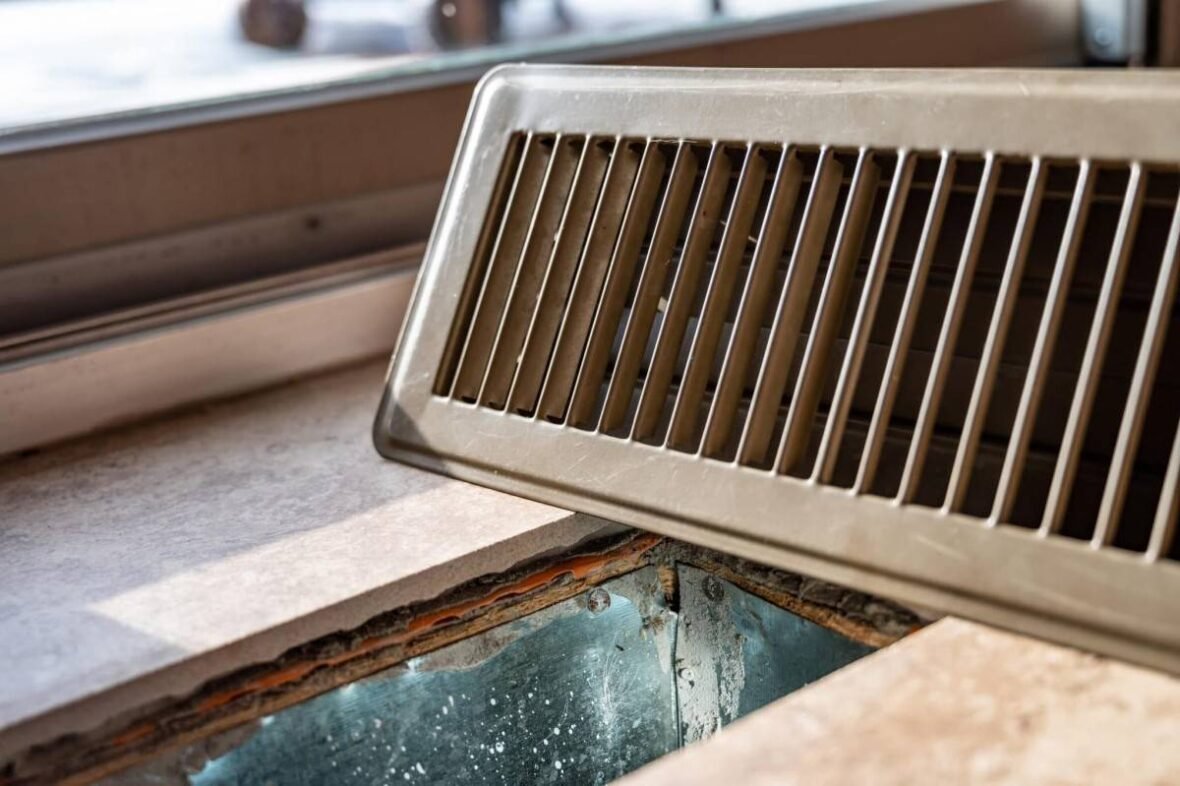
Residential air duct cleaning costs $300 to $1,000 for a typical single-family home in 2026, with the national average falling between $450 and $600. The price per vent runs $25 to $50, and the price per square foot of living space runs $0.15 to $0.35. The wide range exists because duct cleaning is priced by the size of the duct system — the number of supply and return vents, the linear feet of ductwork, and the number of HVAC units — not by a flat rate that applies to every house.
A legitimate duct cleaning performed to NADCA (National Air Duct Cleaners Association) standards involves a truck-mounted or portable high-powered vacuum connected to the main trunk line, compressed air agitation of each branch duct, and hand-cleaning of each supply register and return grille. A $49 whole-house special advertised on a postcard is not that service. It is a bait-and-switch: the technician arrives, spends 20 minutes vacuuming three registers, then presents a $900 estimate for the “full cleaning” that the $49 special did not cover. The legitimate price is $350 to $600. Any quote below $250 or above $1,200 for a standard single-family home should be scrutinized with the same skepticism as a $49 special.
Air Duct Cleaning Cost by Home Size and Number of Vents
| Home Size | Typical Vent Count | Price Range | Average Price |
| Small (< 1,200 sq ft) | 8-12 vents | $250-$400 | $325 |
| Medium (1,200-2,000 sq ft) | 12-18 vents | $350-$600 | $475 |
| Large (2,000-3,000 sq ft) | 18-25 vents | $500-$800 | $650 |
| Very Large (3,000+ sq ft) | 25-40 vents | $700-$1,200 | $900 |
The vent count is the primary pricing metric for most duct cleaning companies. Each supply vent and each return grille counts as one vent. A 2,000-square-foot house typically has 10 to 14 supply vents and 2 to 4 return grilles, for a total of 12 to 18 vents. At $30 to $45 per vent, the total is $360 to $810. Houses with multiple HVAC systems — a separate furnace for the basement, or a second system for an addition — add $100 to $200 per additional system because the vacuum must be disconnected from the first trunk line and reconnected to the second.
The square footage of the house is a secondary pricing metric. It correlates with the length of ductwork, but not perfectly: a compact 3,000-square-foot colonial with a central mechanical room may have shorter total duct length than a sprawling 2,000-square-foot ranch with ducts running to four corners of the house. The vent count is the more reliable metric because each vent represents the end of a branch duct, and each branch duct requires roughly the same amount of cleaning labor regardless of the house size.
When preparing for this type of service, homeowners can look into certified local contractors to ensure the work is completed correctly. Businesses like Roberts Air, LLC can provide a clear assessment of your entire ventilation setup to evaluate its current structural needs. Checking these elements before a major cleaning helps identify any loose fittings or minor system issues that could otherwise impact overall heating and cooling performance over time.
What a Legitimate Duct Cleaning Includes
A NADCA-standard duct cleaning is not a quick vacuum pass. It is a systematic cleaning of every component of the air distribution system, and the price should include all of the following:
- Supply ducts: Each branch duct is cleaned from the register opening back to the main trunk line using a compressed air whip or a rotary brush. The compressed air agitates debris off the duct walls, and the vacuum at the trunk line captures it.
- Return ducts: The return air path is cleaned from each return grille back to the furnace or air handler.
- Supply and return plenums: The metal boxes directly above and below the furnace or air handler are vacuumed and wiped clean.
- Furnace or air handler interior: The blower compartment, the blower wheel, the evaporator coil (if accessible), and the heat exchanger surfaces are vacuumed and brushed clean. A dirty blower wheel is the single largest source of recirculated dust in a forced-air system, and cleaning it is the highest-value part of a duct cleaning service.
- Supply registers and return grilles: Each register and grille is removed, washed with a degreaser, and reinstalled.
The blower wheel test: Before hiring a duct cleaning company, open the blower compartment of your furnace and look at the blower wheel with a flashlight. If the blades are packed with a thick layer of gray dust and lint, ask each company specifically whether they include blower wheel cleaning in their standard price. A company that charges extra for this or omits it entirely is not doing a complete cleaning.
For individuals interested in pursuing a career in maintaining these intricate climate control systems, obtaining proper technical education is an important first step. Aspiring technicians can view our programs to find specialized training pathways that cover comprehensive system evaluations, hands-on diagnostics, and industry-standard cleaning protocols. Developing these practical skills ensures that future professionals can accurately identify necessary maintenance tasks and deliver reliable service to homeowners.
Add-On Services and Their Costs
| Add-On Service | Typical Cost | Worth It? |
| Dryer vent cleaning | $75-$150 | Yes — reduces fire risk, done annually |
| Sanitizer / antimicrobial fogging | $100-$250 | Only if there is confirmed mold growth |
| Mold treatment | $500-$2,000+ | Only with lab-confirmed mold; get a separate mold remediation company |
| Furnace / AC coil cleaning (deep) | $100-$250 | Yes if the coil is visibly dirty |
| Air filter upgrade / media cabinet | $100-$300 | Yes if switching from 1-inch to 4-inch media |
| Duct sealing (Aeroseal) | $1,500-$3,000 | Only if a duct leakage test shows >20% leakage |
Sanitizer fogging is the most aggressively marketed add-on and the least likely to provide any measurable benefit. The EPA does not recommend routine use of chemical biocides or sanitizers in ductwork unless there is laboratory-confirmed mold growth.
A fogged sanitizer that is applied to dusty ducts does not “sanitize” the dust. It wets the dust, and the dust becomes a paste that hardens in place.
If a duct cleaning company pushes sanitizer fogging as an essential part of the service, get a second opinion from a company that does not sell chemicals.
Regular maintenance on your mechanical components can minimize the necessity of these extra treatments. Keeping your HVAC system clean and properly calibrated supports seasonal energy efficiency and helps reduce overall operating wear. Homeowners can find more details about specialized system checks and routine cleaning schedules to preserve their equipment over time by addressing minor restrictions before they affect daily indoor comfort.
The $49 Duct Cleaning Scam and How to Avoid It
The $49 whole-house duct cleaning is the most persistent scam in the HVAC industry. The postcard, the social media ad, or the telemarketing call offers an impossibly low price ($49, $69, or $99) for a complete duct cleaning. When the technician arrives, one of several things happens:
- The technician spends 15 minutes vacuuming three supply registers, declares the job done, and leaves. The ducts were not cleaned. The blower wheel was not touched. The return ducts were ignored.
- The technician shows the homeowner a photograph of “mold” in the ducts (a generic photograph, not the homeowner’s ducts) and pressures them into a $900 mold remediation add-on.
- The technician removes one register, takes a photograph of the dust inside that individual duct (which is normal in every house), and presents a $700 estimate for the “heavy contamination” cleaning that the $49 special does not cover. The $49 was never the price. It was the price of the sales call.
A legitimate duct cleaning company charges $350 to $600 for a standard house, quotes the price over the phone based on the number of vents and HVAC systems, and does not change the price when the technician arrives unless the technician finds a condition that was genuinely not disclosed on the phone call, such as a second HVAC system or an additional return grille in a finished basement that the homeowner forgot to mention.
Three questions to ask before scheduling: (1) “Is your price per vent, per square foot, or a flat rate? What is the total for my house with X vents and Y HVAC systems?” (2) “Does your standard price include cleaning the blower wheel and the evaporator coil?” (3) “Are your technicians NADCA-certified?” If the answers are vague, evasive, or the price changes when you ask question 2, hang up and call the next company.
When Duct Cleaning Is Necessary — and When It Is Not
The EPA’s official position on duct cleaning is measured: “Duct cleaning has never been shown to actually prevent health problems. Neither do studies conclusively demonstrate that particle levels in homes increase because of dirty air ducts.” This is not an argument against duct cleaning. It is an argument against the idea that duct cleaning is a routine health maintenance task like changing the furnace filter.
Duct cleaning is warranted in these specific situations:
- Visible mold growth inside the ducts, on the registers, or on the blower wheel — confirmed by laboratory testing, not by a photograph shown to you by a salesperson.
- Vermin infestation — rodents, insects, or birds nesting in the ducts.
- Excessive debris that is visible coming from the registers when the blower runs, or a measurable reduction in airflow from specific registers caused by debris blockage.
- After major construction or renovation that generated drywall dust, sawdust, or other particulate that the furnace has been circulating through the ductwork for weeks.
- After a flood or water event that introduced standing water into the ducts.
Duct cleaning is not warranted as a routine maintenance service for a house where the furnace filter is changed regularly, the registers are vacuumed occasionally, and no specific contamination event has occurred. The dust that accumulates on the inside walls of the ducts stays there — it does not blow off the walls and into the room. Changing the furnace filter and cleaning the blower wheel every 3 to 5 years addresses the dust that actually recirculates through the system.
Routine upkeep of these primary mechanical elements helps support reliable home heating and cooling capacity throughout the changing seasons. Addressing small maintenance tasks early can help avoid sudden failures or unexpected system strain when weather conditions fluctuate. Homeowners who want to establish a dependable seasonal care routine can continue reading to understand how simple preventative steps protect critical equipment and sustain home comfort.
The dust on the duct walls is inert.
Air Duct Cleaning Costs by Region
| Region | Typical Range (2,000 sq ft home) | Average Price |
| Southeast | $300-$500 | $400 |
| Midwest | $350-$550 | $450 |
| Northeast | $450-$750 | $600 |
| West Coast | $500-$900 | $700 |
| Mountain West | $400-$650 | $525 |
DIY vs. Professional Duct Cleaning
A homeowner with a shop vacuum, a long flexible brush, and a weekend can clean the accessible portions of the ductwork: the first 2 to 3 feet of each supply duct reachable through the register opening, and the return ducts accessible from the basement or attic. What a homeowner cannot do is clean the entire length of each branch duct back to the trunk line, clean the trunk line itself, or clean the blower wheel and evaporator coil without disassembling the furnace cabinet.
The professional equipment that justifies the $450 to $600 cost is the truck-mounted vacuum that connects to the main trunk line and pulls negative pressure through the entire duct system, combined with the compressed air tools that agitate debris off the duct walls from 20 to 30 feet away from the register opening. A shop vacuum at the register opening pulls air from the first 3 feet of the branch duct. The remaining 15 to 25 feet of duct between the register and the trunk line are untouched. DIY duct cleaning is better than nothing for the register openings. It is not a substitute for a professional cleaning of the full duct system.
FAQ: Common Questions About Air Duct Cleaning
How often should air ducts be cleaned?
NADCA recommends duct cleaning every 3 to 5 years for most homes. Homes with pets, smokers, recent construction, or occupants with allergies or asthma may benefit from cleaning every 2 to 3 years. The furnace filter should be changed every 30 to 90 days regardless of the duct cleaning schedule. A clean filter does more to maintain indoor air quality than duct cleaning does.
Does duct cleaning reduce energy bills?
Cleaning the blower wheel and the evaporator coil can improve airflow by 5% to 15% if those components were heavily fouled, which translates to a small reduction in the blower motor’s energy consumption. Cleaning the ducts themselves — the sheet metal tubes that carry the air — has no measurable effect on energy efficiency. The friction loss in a residential duct system comes from the duct design and the register grille resistance, not from a layer of dust on the duct walls.
While cleaning the sheet metal channels might not directly alter your system’s physics, ensuring proper seasonal upkeep for your broader heating and cooling elements is a different matter. Consulting a certified HVAC contractor to inspect your blower system, clean the internal coils, and evaluate total airflow dynamics supports daily energy efficiency. Meticulous care for these vital components minimizes mechanical strain and sustains a reliable indoor climate all year round.
While cleaning the metal channels might not impact your monthly utility costs, maintaining the mechanical parts of your heating and cooling system is a different matter. Keeping the blower wheel and coils free of debris supports better airflow and helps the entire unit function more reliably throughout the year. For homeowners who want to ensure their system remains in peak condition, it can be helpful to Learn more about the specific maintenance tasks that actually contribute to long-term performance and indoor air quality. Consistent care for these internal components can prevent unnecessary wear and keep your living environment comfortable without the need for frequent, costly repairs. Do not buy duct cleaning on the promise of lower energy bills. Buy it to remove contaminants from the air distribution system.
A Legitimate Duct Cleaning Costs $450 to $600 — and Is Worth It When You Need It
The $49 special is a sales call disguised as a service. The $900 sanitizer add-on is a chemical solution to a problem you probably do not have. The legitimate NADCA-standard duct cleaning — vacuuming the trunk line, agitating each branch duct, cleaning the blower wheel and the evaporator coil, washing the registers and grilles — costs $450 to $600 for a typical home and takes a two-person crew 3 to 5 hours to complete.
Schedule duct cleaning when you have a specific reason: visible mold, vermin, post-construction dust, or a blower wheel packed with years of accumulated lint. If none of those conditions apply and your furnace filter is changed regularly, the ducts are fine. The dust on the walls is not going anywhere. The dust on the blower wheel is going everywhere, every time the furnace runs. Clean the blower wheel. The ducts can wait.