

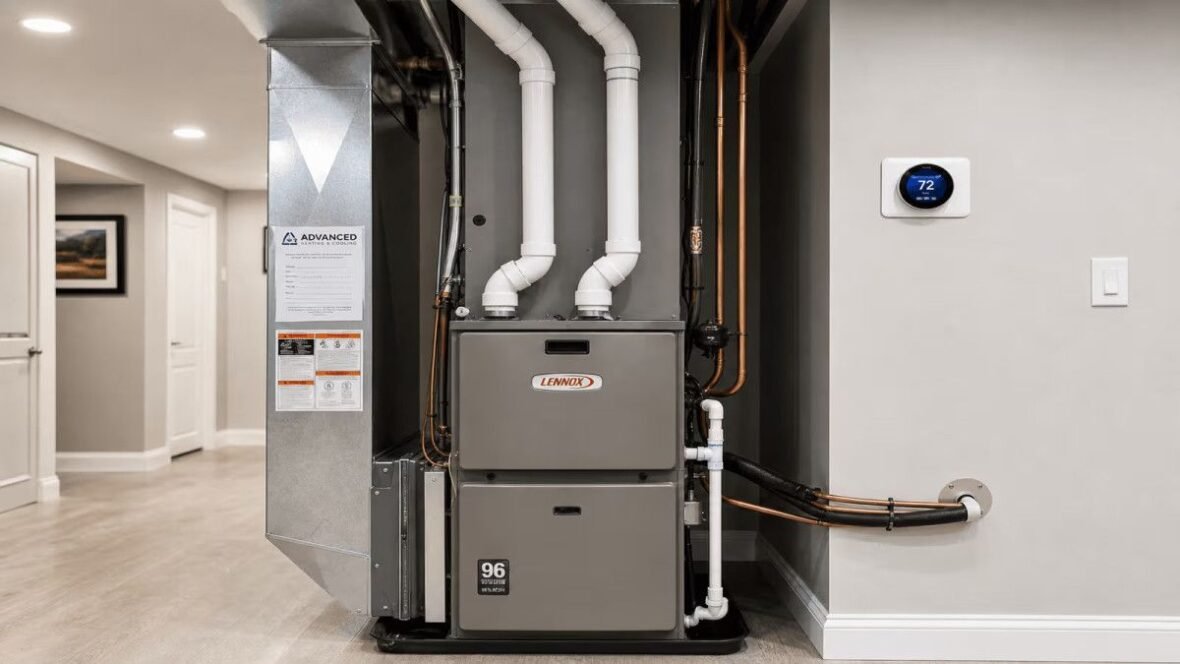
New ductwork costs $2,500 to $12,000 for a typical single-family home in 2026, with the national average around $5,000. The price is driven by four variables: the size of the house, the accessibility of the installation path (new construction open walls vs. retrofit finished walls), the duct material (flex, galvanized steel, or fiberboard), and the local labor rate. The raw materials — the ducts, fittings, registers, dampers, and insulation — account for roughly 30% to 40% of the total cost. The labor to fabricate, route, hang, seal, and balance the system accounts for the remaining 60% to 70%.
Ductwork is priced by the linear foot and by the square footage of the house. A 2,000-square-foot house typically requires 150 to 250 linear feet of ductwork, with larger homes requiring proportionally more. The cost per linear foot installed ranges from $12 to $30, depending on the material and the installation difficulty. A house with the furnace in the basement and bedrooms on the second floor requires more linear feet of duct — and more labor to route those ducts through walls and ceilings — than a single-story ranch with the furnace in the center of the house.
Homeowners often underestimate the role that efficient air distribution plays in their overall energy bills. When ductwork is improperly sized or leaking, even the most advanced furnace or air conditioner has to work twice as hard to maintain a consistent temperature.
Poor distribution channels can also lower overall energy efficiency and cause unnecessary strain on the system’s internal elements. Consulting a qualified HVAC contractor ensures that your home layout receives the precise air volume required for balanced climate control. Experienced professionals can calculate systemic flow needs, identify weak output areas, and install pathways that support uniform indoor comfort throughout the entire property.
Researching the best hvac near me can provide insights into local pricing and common regional issues, such as humidity control or extreme temperature shifts. For those living in areas with distinct seasonal changes, matching the system layout to the local environment ensures long-term operational efficiency.
Finding reliable HVAC contractor support for Watertown properties can help ensure your airflow configuration is tailored to handle specific regional climate challenges. Experienced local technicians can evaluate the existing layout, verify code requirements, and suggest proper material upgrades to enhance general durability. Addressing these foundational setup needs early can lower future energy expenses and support consistent climate control throughout the building.
Consulting with established regional service providers can offer clarity on standard equipment pairings and structural configurations. For homeowners navigating these regional installation demands, partnering with an experienced team like The Wright Air Conditioning & Heating Co. can help determine whether a full update or targeted remediation is more appropriate. Evaluating the state of current delivery channels alongside regional climate demands supports better long-term system efficiency and balances air volume predictably throughout the home. Understanding these variables helps in budgeting for a complete replacement versus a simple repair. Ultimately, investing in high-quality materials and professional installation ensures that your home remains comfortable throughout the year while minimizing unexpected maintenance costs.
New Ductwork Cost by House Size
| House Size | Typical Duct Length | New Construction | Retrofit (Finished Home) |
| 800-1,200 sq ft | 80-150 ft | $1,500-$3,500 | $2,500-$5,500 |
| 1,200-2,000 sq ft | 150-250 ft | $3,000-$6,000 | $5,000-$9,000 |
| 2,000-3,000 sq ft | 250-400 ft | $5,000-$9,000 | $8,000-$15,000 |
| 3,000+ sq ft | 400-600+ ft | $8,000-$15,000 | $12,000-$22,000 |
The retrofit premium — the additional cost of installing ductwork in a finished house compared to new construction — is 50% to 100%. In new construction, the ductwork goes in before the drywall, and the installer has unrestricted access to every wall cavity and ceiling joist bay. In a retrofit, the installer must work through existing access points, fish ducts through finished walls, and cut strategic holes in drywall that must be patched afterward. The extra time spent navigating around obstacles is the primary driver of the retrofit cost premium.
While the physical labor of running ducts through finished walls accounts for much of this expense, it is also important to consider how the layout affects long-term system health. Strategic planning can help avoid common pitfalls like restricted airflow or poor temperature balance between floors. Partnering with a specialized team like Albany Mechanical Services Inc can help homeowners determine the most efficient routing paths for their specific home layout. By assessing the structural constraints of a property before the project begins, technicians can ensure the new configuration supports the furnace or air conditioner effectively, leading to more consistent indoor comfort and potentially lower monthly energy bills.
Ductwork Cost by Material Type
| Material | Cost per Linear Ft (Installed) | Lifespan | Best Application |
| Flex duct (R-6 insulated) | $8-$15 | 15-25 years | Retrofit branch ducts, tight spaces |
| Galvanized steel (rectangular) | $15-$25 | 40-60 years | New construction trunk lines, basements |
| Galvanized steel (round spiral) | $18-$35 | 50-75 years | Exposed ducts, commercial, aesthetic |
| Fiberglass duct board | $12-$20 | 20-30 years | Budget new construction, insulated |
Flex duct is the least expensive material and the most common choice for residential retrofit branch ducts. It is a wire-reinforced plastic tube with built-in fiberglass insulation. Flex duct costs less than metal because it requires fewer fabricated fittings — it can bend around corners — and installs faster. The trade-off: flex duct has higher airflow resistance than smooth metal duct, so the HVAC system must be designed with that resistance in mind. Flex duct runs must be pulled tight and kept short (under 15 feet is ideal). A sagging flex duct creates a U-bend that doubles the airflow resistance of that run.
Galvanized steel duct is the premium material. It is rigid, smooth on the inside for minimal airflow resistance, and lasts the life of the house. Rectangular galvanized duct is standard for main trunk lines in basements. Round spiral duct is used for exposed ductwork where the duct is a visible design element — finished basements, open-ceiling commercial spaces, and modern industrial-style homes. The cost premium for metal over flex is $7 to $15 per linear foot, and that premium buys a material that outlasts flex by 20 to 50 years.
What the Total Cost Includes: Beyond the Duct Itself
The linear foot of duct is the largest line item, but the fittings, registers, dampers, insulation, and sealing materials add 40% to 60% to the material cost. A quote that covers only the ducts is not a complete quote.
- Fittings: Elbows, wyes, reducers, takeoffs, and end caps — $10 to $50 each. A typical installation uses 15 to 30 fittings.
- Supply registers and return grilles: $10 to $30 per register, $15 to $50 per return grille. A 15-vent house: $200 to $500 in visible hardware.
- Volume dampers: $10 to $20 each, one per branch duct, for balancing airflow between rooms.
- Duct insulation: $2 to $4 per linear foot for ducts in unconditioned spaces. Flex duct includes insulation. Metal duct requires a separate wrap.
- Mastic sealing: $1 to $2 per linear foot. Every seam and joint in a metal system must be sealed. Unsealed ducts leak 20% to 30% of conditioned air.
- Permits: $100 to $300 for a mechanical permit.
The most expensive ductwork mistake: Installing new ductwork that is undersized for the HVAC system. A Manual D load calculation — the ACCA standard for residential duct design — sizes each branch duct to deliver a specific CFM of airflow to each room. A contractor who skips the Manual D and sizes the ducts by rule of thumb produces a system where the farthest bedroom is cold in winter and hot in summer. The cost of a Manual D calculation is $200 to $500 and is included in the price of a professionally designed duct system. The cost of undersized ductwork is a lifetime of uneven temperatures.
Proper system design ensures that each room receives the correct volume of air, which helps maintain consistent temperatures and prevents the mechanical strain that leads to premature equipment failure. When these delivery channels are sized correctly, the heating unit can operate within its designed parameters without being forced to work harder to push air through restricted pathways. Regular maintenance and timely furnace repair can further support these efficiency gains by ensuring that all components of the heating and cooling system remain in good working order. Keeping up with these foundational needs contributes to a more balanced indoor environment and may help lower monthly utility expenses.
Ductwork Replacement Cost vs. Full System Replacement
Replacing only the ductwork — leaving the existing furnace and AC in place — costs $3,000 to $9,000 for a typical home. Replacing the ductwork as part of a full HVAC system replacement adds $3,000 to $8,000 to the total project cost, depending on how much of the existing ductwork is reusable. Contractors typically offer a package discount of 10% to 15% when the ducts and the equipment are replaced together, because the crew is already on site, the equipment is being disconnected and reconnected anyway, and the ductwork connections to the new equipment must be fabricated regardless.
If the existing ductwork is asbestos-wrapped — common in homes built before 1980 — replacement requires professional asbestos abatement before the new ducts can be installed. Asbestos abatement costs $5,000 to $15,000 depending on the extent of the ductwork and the accessibility. Asbestos ductwork is a regulated hazardous material and cannot be removed by a standard HVAC contractor.
Regional Ductwork Costs
| Region | Typical Range (2,000 sq ft Retrofit) | Labor Rate / hr |
| Southeast | $3,000-$6,000 | $60-$85 |
| Midwest | $4,000-$7,500 | $70-$95 |
| Northeast | $5,500-$10,000 | $90-$130 |
| West Coast | $6,000-$11,000 | $95-$140 |
| Mountain West | $4,500-$8,000 | $75-$105 |
FAQ: Common Questions About Ductwork Costs
Can I avoid the cost of ductwork by installing a mini-split instead?
Yes. Ductless mini-split systems do not use ductwork at all. Each indoor unit mounts on the wall or ceiling in the room it serves, connected to the outdoor condenser by refrigerant lines, not air ducts. A multi-zone mini-split system for a 2,000-square-foot house costs $8,000 to $15,000 installed — roughly comparable to a new central AC and furnace with new ductwork. The advantage of a mini-split is that the cost is all equipment, not ductwork, and the system provides zone-by-zone temperature control that a single-zone central system cannot match. The disadvantage is that each room or zone needs a visible indoor unit on the wall.
How much does it cost to add a return duct to a room that is always cold?
$300 to $800, depending on the distance from the room to the existing return trunk line and the accessibility of the ceiling or wall cavity. A room without a dedicated return duct relies on the gap under the door to allow air back to the central return. If the door is closed, the room pressurizes when the blower runs, supply airflow drops, and the room stays cold. Adding a return duct — or a simple jumper duct through the wall to an adjacent room that has a return — restores proper airflow and evens the temperature. A jumper duct costs $200 to $500 and does not require connecting to the main return trunk.
New Ductwork Is an Investment in the Air Distribution System
New ductwork costs $5,000 on average for a typical home, with the final price determined by the house size, the accessibility, and the material choice. Flex duct in an open-attic retrofit costs $8 to $15 per foot. Galvanized steel in a new-construction basement costs $15 to $25 per foot. The difference in upfront cost is $1,500 to $3,000 for a 200-foot system. The difference in lifespan is 20 to 50 years.
When comparing quotes, verify that every quote includes the same scope: the same linear feet of duct, the same number of supply and return runs, the same material, the same insulation, and the same mastic sealing. A $3,500 quote that omits return ducts, uses uninsulated flex, and skips the mastic is not cheaper than a $6,000 quote that includes everything. It is a different product. Get a Manual D load calculation with the quote. If the contractor cannot provide one, they are guessing at the duct sizes. Guessing is not designing. A duct system that is guessed at costs more in discomfort than it saves in installation.