

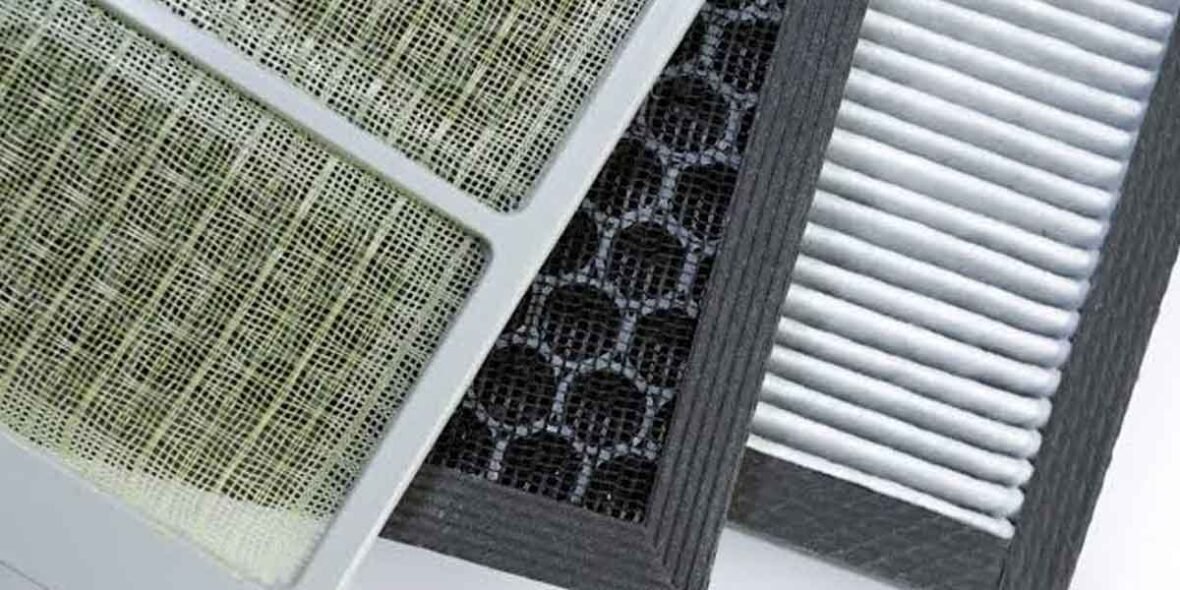
There are six main types of hvac filters: fiberglass, pleated, washable, electrostatic, media or HEPA-style, and carbon. They differ by material, MERV rating, lifespan, and cost, and the right one depends on your home: a basic 1-inch fiberglass filter changes every 30 days and mainly protects the equipment, while a pleated filter with a MERV 8 to 11 rating gives most homes the best balance of filtration and airflow. Higher-MERV and HEPA filters filter more but restrict airflow, so the choice is a tradeoff between your blower and your air-quality needs, not a race to the highest number.
The framework below walks the types first, then the MERV scale, then your household conditions, so the filter you land on is the one your system can actually pull air through. Sizing and change frequency are part of the same decision.
The Types of HVAC Filters at a Glance
Six types cover almost every residential system: fiberglass, pleated, washable, electrostatic, media or HEPA-style, and carbon. The table below maps each type to its MERV range, lifespan, and who it fits, so the decision starts from the household rather than from a product name.
| Filter type | Material and MERV | Lifespan | Who it fits |
|---|---|---|---|
| Fiberglass | 1-inch spun glass, MERV 1-4 | About 30 days | Budget owners; protects the equipment, filters little else |
| Pleated | 1-inch or 4-inch polyester, MERV 8-13 | 90 days (1-inch), 3-6 months (4-inch) | Most homes; the best filtration-per-airflow balance |
| Washable | Reusable mesh, MERV 5-8 | Reusable; clean every 1-3 months | Owners who want to skip recurring purchases; must dry fully |
| Electrostatic | Charged fibers, MERV 8-12 | 90 days to 6 months | Homes wanting mid-level filtration without high media cost |
| Media / HEPA-style | Deep media, MERV 13-16+ | 6-12 months | Allergy-sensitive homes; needs a filter cabinet or media box |
| Carbon | Carbon-coated, low particle MERV | 1-3 months | Odor or VOC control; used with a particle filter, not alone |
The type determines the lifespan, and the household determines the type.
Fiberglass and pleated filters are the two most common, and moving from fiberglass to pleated is the single biggest upgrade most homes can make without touching the equipment.
Fiberglass filters are the least expensive and the least effective; they exist to protect the equipment, not the air. Pleated filters fold the media to multiply the surface area, which is why they filter better at the same thickness, and the 4-inch versions add enough surface to last months instead of weeks.
MERV Ratings: What the Number Means
MERV, short for minimum efficiency reporting value, scores how well a filter catches particles of different sizes, and the scale runs from 1 to 16 for residential filters. MERV 5 filters roughly 20 percent of particles in the 3.0 to 10.0 micron range, and each step up filters finer particles at the cost of more airflow resistance.
The EPA’s MERV rating guide is the reference for what each level captures, from MERV 1 to 16. The practical band for most homes is MERV 8 to 11: enough filtration for dust, pollen, and pet dander without choking the blower.
The HEPA-versus-MERV question follows the same rule.
HEPA is not a MERV number; it is a filter standard that captures 99.97 percent of particles at 0.3 microns, and true HEPA in a central system needs a media cabinet and a blower rated for the pressure drop. A MERV 13 to 16 media filter is the residential way to get near-HEPA performance without the equipment redesign.
MERV 8 captures most pollen, dust mites, and mold spores; MERV 11 adds fine dust and smoke particles; MERV 13 and up approach the filtration level used in hospitals. Below MERV 8, the filter is mainly equipment protection, which is why the band from 8 to 11 is the default for homes.
Is MERV 11 too high for home? Only if the system cannot move air through it. Newer systems with 4-inch filter slots handle MERV 11 comfortably; older systems with 1-inch slots and marginal blowers may not. If the system whistles or runs long cycles after the swap, the filter is more than the blower can pull.
Systems with a 4-inch slot can usually step up a band; systems with a 1-inch slot should stay conservative with the filter depth they were built for.
Matching the Filter to Your Home
Match the filter to what your household actually produces: pets, allergies, smoke, or a normal mix. The rules below give a concrete MERV and change frequency for each case, and the change frequency is where the hvac maintenance checklist picks up.
No pets and no allergy sufferers: a pleated MERV 8 to 11 filter changed every 90 days covers most homes.
Pets in the house: stay in the same MERV band but change every 30 to 60 days, because dander loads the media faster.
Allergy or asthma sufferers: move to MERV 11 to 13, and change a 1-inch filter every 30 days or a 4-inch filter every 60 to 90 days. Smoke, wood-burning fireplaces, or nearby construction: check the filter at least every 30 days, and MERV 13 is the level commonly recommended for wildfire smoke events.
Whatever the household, match the exact size printed on the filter frame.
A filter that is even slightly too small lets unfiltered air bypass the media and defeats the whole point, and the hvac maintenance checklist covers the rest of the schedule around it.
Seasonal loads change the schedule too. Summer dust and winter wood-burning load the filter faster than spring and fall, so checking at the season change catches the worst of both before the system runs hard.
The Tradeoffs: Filtration, Airflow, and Cost
Filtration and airflow pull against each other: higher MERV catches more but restricts more, and the blower decides how far you can go. A 4-inch pleated filter at the same MERV as a 1-inch one filters better in practice, because the extra surface area lets the blower breathe.
The cost ladder follows the type: fiberglass filters cost the least per change, pleated filters cost a little more and last three times as long, and media or HEPA-style filters cost the most but last six to twelve months.
Washable filters spread the cost over years but only if you actually clean them, and a washable filter that is not dried properly grows mold.
Replacement filters for a standard 1-inch slot run a few dollars each for fiberglass and a little more for pleated, so the yearly cost difference between the two is usually under fifty dollars.
The failure mode is the reason the airflow side matters. A filter that is too restrictive starves the blower, which makes the system short-cycle and can freeze the evaporator coil, and the fix is not a stronger filter but a compatible one. One r/hvacadvice thread shows the pattern from the owner’s side: a system struggling to reach temperature, checked out fine on refrigerant, and the technician’s first question was what filter was in it.
“He then asked me what filter I use and I told him I get them at Costco, 16×25 on the 2nd floor and a 20×30 on the 3rd floor… HVAC guy immediately said that it’s no good and to change it.”
– r/hvacadvice, August 2026 (493 upvotes)
A filter has to fit the system, and the wrong size or the wrong type shows up as a temperature problem, a frozen coil, or a dead compressor later.
The symptom check works in both directions: a filter that is too small leaks air around the frame, and a filter that is too dense starves the blower. Both produce the same complaint, weak airflow from the vents, which is why the frame size and the MERV band matter as a pair.
Types Of HVAC Filters FAQ
What are the different types of HVAC filters?
The six main types are fiberglass, pleated, washable, electrostatic, media or HEPA-style, and carbon. They differ by material, MERV rating, lifespan, and cost, and most homes land on a pleated filter in the MERV 8 to 11 range.
Which filter is better, HEPA or MERV?
HEPA is a filter standard that captures 99.97 percent of 0.3-micron particles, while MERV is a rating scale up to 16 for residential use. A MERV 13 to 16 media filter is the practical residential equivalent of HEPA without needing a system redesign.
What type of filter is best for HVAC?
For most homes, a pleated MERV 8 to 11 filter in the size printed on the frame is the best balance of filtration, airflow, and cost. Higher MERV suits allergy-sensitive or smoke-affected households, provided the blower can pull air through it.
Is MERV 11 too high for home?
MERV 11 is fine for homes with a blower that can handle the airflow resistance, especially with a 4-inch filter slot. Older systems with 1-inch slots and weak blowers may struggle, so the symptom check is whether the system whistles or runs long cycles.
Start from the household, read the MERV band, and let the blower veto the number. The filter that fits your system and your air-quality needs beats the one with the biggest number on the box.