

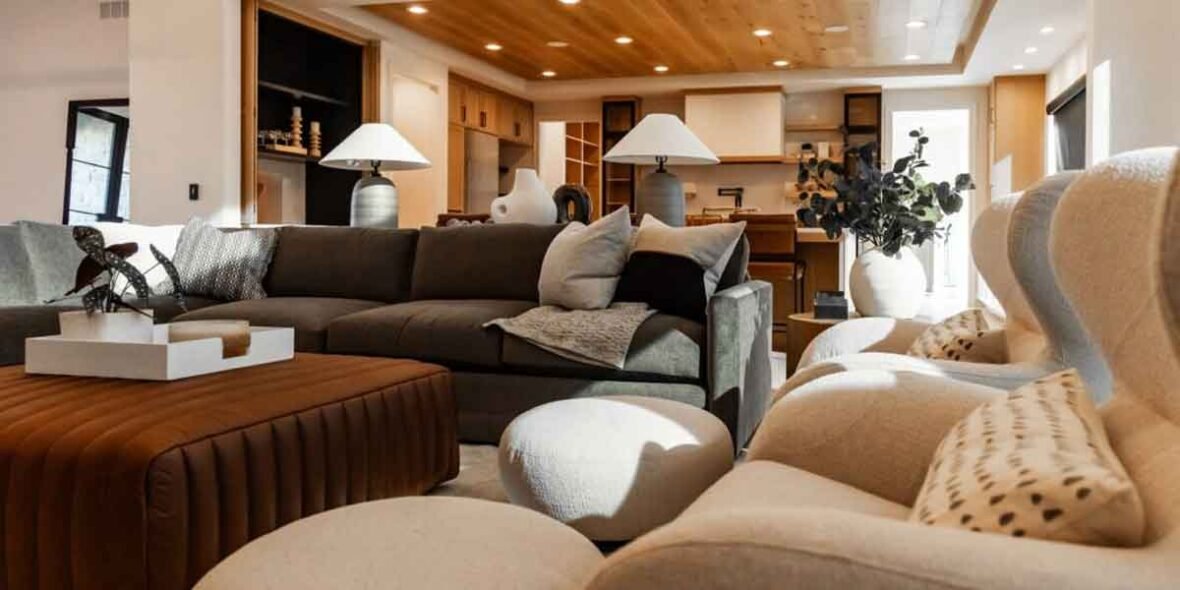
A lot of homeowners assume that opening up a living space means knocking down walls or adding square footage. Big renovations can absolutely change how a room feels — but they’re rarely the only route, and often not the necessary one.
More often, openness comes from a handful of smaller decisions working together. The light, the sightlines, the furniture, the materials — each one nudges how spacious a room feels, and when they’re handled with some care, even a modest room can feel bright and easy to be in. The aim isn’t really to trick the eye into seeing a bigger room. It’s to make the space genuinely nicer to live in day to day.
Let light move through the room
Daylight is one of the most powerful tools you have. A bright room reads as more open because light flattens the visual barriers and softens the shadows — corners stop feeling boxed in, surfaces gain definition, and the room picks up a depth that lamps alone never quite manage.
It’s why a room with good daylight feels larger than a darker room of exactly the same size. And the effect gets stronger when the light can actually travel — when it isn’t being stopped dead by an oversized sofa, a heavy finish, or a pile of clutter on every surface.
Open up the sightlines
The eye responds to how far it can see. Block the view with obstacles and a room feels more cramped than it really is; leave the sightlines clear and the same space feels larger and better connected.
This doesn’t require an open floor plan. Usually it’s smaller than that — pulling a tall piece out of a doorway’s line, choosing storage that doesn’t wall off the room, arranging the décor so the eye has somewhere to travel. The farther it can run before hitting something, the more open the room feels.
Choose furniture that supports the space
Furniture should work with a room, not wrestle it. The most common mistake is simply too much of it — even lovely pieces make a space feel crowded when every wall and corner is occupied.
A more selective hand wins almost every time. Well-proportioned pieces with room to breathe around them let the space relax, and they keep the walking paths clear, which makes the room feel more comfortable and more functional at once. Openness is often created by what you leave out as much as by what you bring in.
Keep the colour palette cohesive
Colour quietly steers how a room is read. A cohesive palette gives the eye a continuous path to follow across the space, so it feels like one room rather than several. Sharp contrasts and frequent colour changes chop a room into smaller visual zones and make it busier than it needs to be.
That’s not an argument for matching everything — variation is what gives a room character and interest. The point is to keep enough consistency that the space reads as connected instead of fragmented. A sofa, a rug, and the walls sharing a common thread of tone will make a small living room feel calmer and more expansive than three competing statements fighting for the eye.
Pay attention to window design
Windows have an outsized say in how open a room feels. They shape the daylight, frame the view, and set the relationship between the inside and everything beyond it. A well-designed opening makes a living space feel larger simply by carrying the eye past the walls and out into the garden.
Well-chosen custom windows sharpen that effect — more daylight, a stronger pull toward the garden, the patio, or whatever landscape sits outside. Once the outdoor view becomes part of the room itself, the space feels far less enclosed.
And the benefit isn’t only visual. It changes how you use the room across the day — which chair you gravitate to, where the light’s good enough to read.
Use textiles to soften without overwhelming
Textiles bring comfort, texture, and personality, but they also carry visual weight. Heavy layers, big bold patterns, and dense fabrics can press in on a room and make it feel smaller. Lighter materials hold onto the airy feeling while still giving you warmth and softness.
Curtains are the clearest example: a sheer or a light linen that works with the daylight keeps the room open, where a heavy velvet drawn across the window shuts it down. The same logic runs through the rugs, the cushions, the upholstery — choose them for texture rather than bulk and you add richness without crowding the room. Balance beats quantity nearly every time.
Connect the indoors with the outdoors
Rooms feel larger when they hold a strong relationship with the space outside. A garden view, a patio, even a small planted corner stretches the room past its physical edges, because the eye travels toward it and reads the distance as part of the space.
That connection is especially valuable in a living room, where people spend real time relaxing, hosting, and gathering. When the indoors and outdoors feel linked rather than walled off from each other, the whole home tends to feel more open and more of a piece.
Reduce the visual clutter
Clutter does more than create mess — it shapes perception. Too many ornaments, crowded shelves, surfaces buried under the day’s odds and ends: it all adds up to a visual noise that makes a room feel smaller. Even a beautifully designed space loses its openness when too much is competing for attention.
A more curated approach works better. Let a few pieces you actually care about stand out, and the room gains breathing space and somewhere for the eye to rest. The payoff is a calmer, more inviting space — and, not incidentally, one that’s easier to keep tidy.
Focus on flow, not square footage
People tie openness to size, but comfort usually depends more on flow than on dimensions. A room that’s easy to move through, well lit, and clear in its sightlines can feel surprisingly spacious. A larger room with clumsy layout decisions can still feel hemmed in.
That’s exactly why thoughtful design matters so much. The principles of luxury interior design Palm Beach often focus on creating open, light-filled spaces through careful planning, refined material selections, and a seamless connection between indoor and outdoor living. These timeless design approaches demonstrate that a sense of luxury comes from balance, functionality, and attention to detail rather than square footage alone.
How the elements work with each other tends to count for more than the floor area. Small improvements, aimed at how the room is actually experienced, can do far more than another few square metres ever would.
Final thought
Opening up a living space rarely calls for dramatic change. The most effective improvements usually come from a set of thoughtful decisions working together to lift the light, the flow, and the visual connection to outside.
Daylight, clear sightlines, well-chosen furniture, balanced textiles, and good windows all feed into how spacious a room feels. When they support one another, a living space becomes more comfortable, more functional, and far more enjoyable to spend time in — whatever its actual size.