

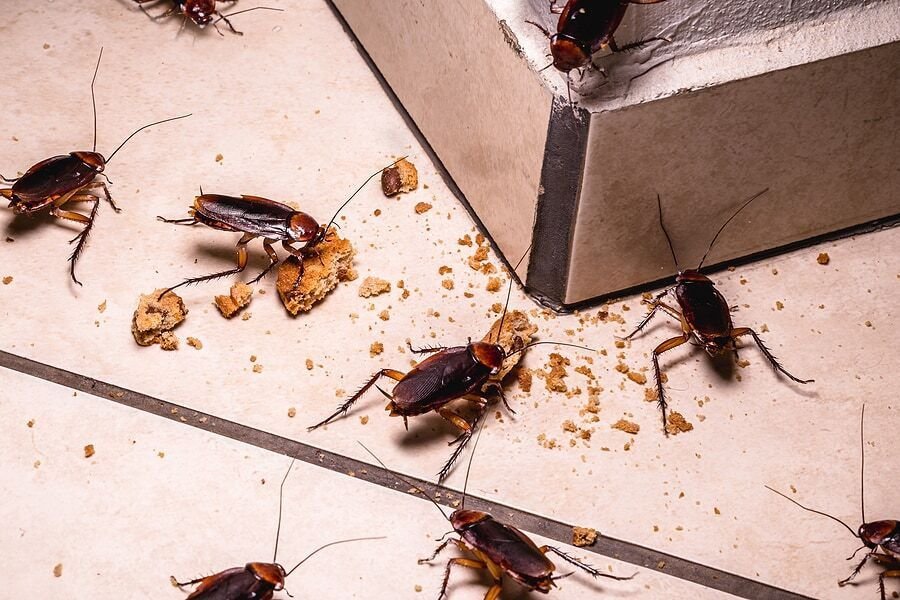
Getting rid of an infested roach population — where the colony is established, reproducing, and spread through multiple rooms — requires a four-week, three-treatment protocol that combines gel bait, insect growth regulator (IGR), insecticidal dust, and aggressive sanitation. A single treatment will not work. The infestation took months or years to develop, and roughly 80% to 90% of the roaches are hidden in wall voids, under appliances, in cabinet voids, and in the cracks around pipes at any given moment. The visible roaches are the foraging population. The hidden roaches are the breeding population — the egg cases, the nymphs, and the adults that never leave the nest. The treatment must kill the foragers, kill the breeders, and prevent the eggs from hatching into a new generation. Three treatments, spaced 10 to 14 days apart, catch every life stage as it emerges: the first treatment kills adults and nymphs, the second kills the nymphs that hatched from eggs after the first treatment, and the third kills the last stragglers. Stopping after one treatment is why most DIY roach treatments fail.
An infestation is defined not by the number of roaches you see, but by the presence of breeding adults and egg cases in multiple locations. If you see roaches during the day, the infestation is severe — roaches are nocturnal, and daytime foraging means the nest is so crowded that some roaches are forced to search for food in daylight. If you see roaches in rooms other than the kitchen and bathroom, the infestation has spread beyond the primary food and water sources. If you see small, wingless roaches — nymphs — the colony is reproducing. If you find egg cases — brown, purse-shaped capsules roughly 1/4 to 1/3 inch long — attached to surfaces or lying in corners, the colony is actively producing a new generation. Any one of these signs means the infestation is beyond the “a few roaches in the kitchen” stage. All of them together mean you need the full treatment protocol described below, and you may need a professional exterminator.
Step 1: Identify the Species — German vs. American vs. Oriental
| Species | Size & Appearance | Where It Lives | Reproduction Speed | Treatment Implications |
| German cockroach | 1/2″ long, light brown, two dark stripes behind head | Indoors only — kitchens, bathrooms, near food/water | Fastest — 4-8 egg cases per female, 30-50 eggs each, 60-day life cycle | Hardest to eliminate; requires IGR + multiple treatments; entire colony is indoors |
| American cockroach | 1-2″ long, reddish-brown, figure-8 marking on head | Sewers, drains, crawlspaces, basements; enters home through drains and cracks | Moderate — 9-10 egg cases per female, 14-16 eggs each, 200-day life cycle | Easier to control; treat drains and perimeter; fewer indoor nests |
| Oriental cockroach | 1″ long, dark brown to black, glossy | Basements, crawlspaces, under sinks, drains — prefers cool, damp areas | Slowest — 8 egg cases per female, 16 eggs each, 300-day life cycle | Focus on moisture elimination; treat basement and crawlspace |
Step 2: Preparation — the Deep Clean That Makes the Treatment Work
Before applying any insecticide, the kitchen and any other infested rooms must be prepared. Insecticides do not work on dirty surfaces — the bait competes with food residue, and the spray and dust cannot penetrate grease and debris. The preparation is labor-intensive and non-negotiable. Skip it, and the treatment fails.
- Remove everything from kitchen cabinets and drawers. Place items in sealed plastic bags or bins in another room. Roaches live in the cracks and hinges of cabinets. The insecticide must reach those cracks. It cannot do so if the cabinets are full of dishes, food, and clutter.
- Clean every surface with a degreasing cleaner. Countertops, cabinet interiors, cabinet exteriors, stovetop, range hood, backsplash, floor. Roaches leave pheromone trails — chemical signals that guide other roaches to food and shelter. Degreasing cleaner removes the pheromones as well as the food residue. If the pheromones remain, new roaches will follow the old trails even after the colony is dead.
- Pull out the refrigerator, stove, and dishwasher. Clean the floor, the walls, and the appliance exteriors behind them. This is where the heaviest roach activity occurs — the warmth and darkness behind appliances is the ideal nesting site. If you cannot pull out the appliances, treat the gaps around them with dust and bait as thoroughly as possible from the front and sides.
- Eliminate all water sources. Fix dripping faucets. Dry the sink and the surrounding counter every night before bed. Empty the pet water bowl overnight. Roaches can survive a month without food. They die within a week without water. The drier you make the environment, the more effective the bait becomes — because the bait gel is also a source of moisture, and a thirsty roach will eat it more readily.
Step 3: The Four-Week Treatment Protocol
Week 1: Gel Bait + Dust + Initial Spray
Apply gel bait — containing fipronil, indoxacarb, or hydramethylnon — in pea-sized dots in every crack, crevice, hinge, and corner in the kitchen and bathrooms: cabinet hinges, under the lip of countertops, behind the refrigerator and stove, around plumbing penetrations under sinks, in the corners of drawers, along the baseboards where the wall meets the floor, and in the corners under the sink. The bait dots should be spaced roughly 6 to 12 inches apart. Apply insecticidal dust — boric acid or diatomaceous earth — into wall voids behind electrical outlets, under cabinets through the toe-kick space, and into the gaps where pipes enter the wall. The dust kills roaches that travel through these hidden passageways between the nest and the foraging areas. Apply a pyrethrin-based contact spray along baseboards and in visible roach hiding spots for immediate knockdown of exposed roaches. The spray kills the foragers. The bait kills the breeders. The dust kills the travelers.
Week 2: Second Bait Application + IGR
Ten to fourteen days after the first treatment, apply fresh gel bait in the same locations. The first bait application has been consumed, degraded, or cleaned away. The second application catches the roaches that survived the first treatment — the late-hatching nymphs, the adults that were deep in the nest and never contacted the bait. Simultaneously, apply an insect growth regulator — methoprene or pyriproxyfen — as a spray or as a bait additive. The IGR does not kill adult roaches. It prevents roach eggs from hatching and prevents nymphs from molting into reproductive adults. The IGR is the component that breaks the reproductive cycle. Without it, the surviving roaches will reproduce, and the infestation will return within months. With it, the surviving roaches will die of old age without producing a replacement generation.
Week 4: Final Bait Application + Monitoring
Twenty-eight days after the first treatment — roughly two weeks after the second treatment — apply a final round of gel bait. This is the “mop-up” treatment for any remaining stragglers. Place fresh glue traps along the baseboards, under the sink, and behind the refrigerator. Check the traps after one week. If the traps are empty or contain only one or two roaches, the infestation is eliminated. If the traps contain more than a few roaches, there is a surviving nest — reapply bait in the area where the traps caught the most roaches. If the infestation persists after three full treatment cycles and aggressive sanitation, the nest is in an inaccessible location — inside a wall cavity, under a concrete slab, or in a neighboring apartment — and the infestation requires professional treatment.
When internal treatments do not fully resolve the issue, the source of the problem often lies in how pests access the structure from the outside. Effectively managing a persistent population requires identifying and sealing the small structural gaps and utility penetrations that allow insects to move between units or enter from the outdoors. Organizations like Mole Miners can help property owners by locating these hidden entry points and implementing exclusion strategies that support long-term control. By addressing these physical vulnerabilities alongside a consistent baiting and IGR protocol, you can create a more resilient environment that discourages future activity and simplifies ongoing maintenance.
The insect growth regulator (IGR) is the difference between a roach treatment that works for 3 months and one that works permanently. Adulticides — sprays, baits, dusts — kill the living roaches. They do not kill the eggs. The eggs hatch 28 to 60 days after being laid, and the emerging nymphs survive the first treatment because they were protected inside the egg case. Without an IGR, those nymphs mature into adults in 40 to 120 days, reproduce, and the infestation returns. With an IGR, the eggs never hatch — or the nymphs that do hatch never mature into reproducing adults. The IGR is the component that prevents the next generation. A roach treatment without an IGR is a temporary solution. A treatment with an IGR is a permanent one.
When to Call a Professional Exterminator
| Sign | What It Means | Why DIY Will Not Work |
| Daytime roach sightings | Severe overcrowding — nest is so full that roaches are forced out during daylight | The colony is too large for consumer-grade baits to eliminate fully |
| Roaches in multiple rooms, not just kitchen/bathroom | Infestation has spread through wall voids to living rooms, bedrooms, closets | The nest locations are too widespread for targeted DIY treatment |
| Roaches in an apartment building | Neighboring units are infested; your treatment kills only your roaches, not theirs | Roaches migrate through shared walls; building-wide treatment is required |
| Allergic reactions or asthma symptoms in household members | Roach allergens — droppings, shed skins, saliva — are at levels that affect respiratory health | The infestation is severe enough to be a health hazard; professional treatment is faster and more thorough |
FAQ: Common Questions About Roach Infestation Treatment
I live in an apartment. Can I get rid of a roach infestation if my neighbors have roaches?
You can eliminate the roaches in your unit. You cannot prevent new roaches from migrating from neighboring units. In a multi-unit building, roaches travel through wall voids, plumbing chases, and electrical conduits. Your treatment kills your roaches. The neighbor’s roaches survive and eventually migrate back into your unit. The solution is a building-wide treatment or continuous preventive treatment: gel bait refreshed every 30 days, dust in wall voids, IGR applied every 4 to 6 months, and every gap around plumbing pipes sealed with expanding foam. Talk to your landlord. A roach infestation that spans multiple units is a building problem, and the building owner is responsible for addressing it in most jurisdictions.
How do I know if the treatment is working and the eggs are being killed?
The number of visible roaches should decline sharply within 3 to 7 days of the first treatment. You should see dead roaches — often on their backs, legs twitching — on floors and countertops in the first 2 to 4 days. You should see fewer and fewer roaches, including fewer small nymphs, after the second treatment with IGR. Glue traps placed after the third treatment should catch near-zero roaches. The clearest sign that the IGR is working is the absence of small nymphs after week 4 — the eggs either did not hatch, or the nymphs that hatched did not survive to become visible. If you continue to see small nymphs after week 6, the IGR application was incomplete, and you should reapply it in the areas where nymphs are still being seen.
Three Treatments, Four Weeks, One IGR. The Infestation Ends When the Cycle Breaks.
Getting rid of an infested roach population requires a four-week, three-treatment protocol: gel bait to kill the foraging adults, insecticidal dust to kill the travelers in the walls, an IGR to prevent the eggs from producing the next generation, and aggressive sanitation to eliminate the food, water, and pheromone trails that sustain the colony. The first treatment kills the visible roaches. The second treatment — with IGR — kills the nymphs that hatched from eggs after the first treatment and prevents the survivors from reproducing. The third treatment cleans up the remainder. Stopping after one treatment is the reason infestations return. Completing all three treatments breaks the reproductive cycle, and the infestation collapses.