

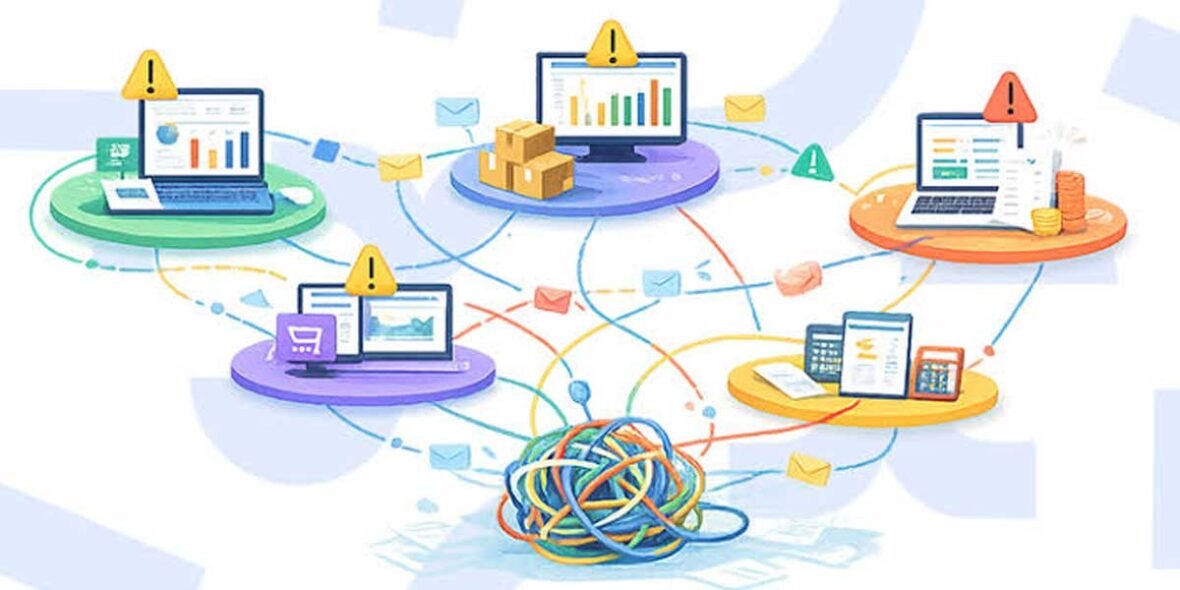
Most growing businesses end up with more software than they expected.
There’s a system for sales. There’s another for customer support. There’s one for accounting. Heck, there might even be one for marketing. Each platform has its own job, which sounds perfectly reasonable… Until you realize they’re all storing information about the same customers.
Then the problems begin.
A customer’s phone number is different in two systems. A sales rep can’t see a recent support conversation. Marketing sends an offer to someone who just complained about the exact same product. Nobody is quite sure which version of the customer record is correct.
Disconnected data creates unnecessary work. More importantly, it can lead to a frustrating customer experience – and that’s now what you want.
Keep reading on to learn how to bring things back under control.
Map Your Critical Workflows
Before connecting every system you own, figure out how information actually moves through the business.
Follow a typical customer from the first interaction to the ends – through a sale, delivery, support request, and follow-up. Where is their information entered? Who uses it? Which system is updated? Where does someone have to copy and paste information manually?
Don’t try to fix everything at once. Start with the workflows that have the biggest impact on customers. Or you might prefer to focus on what takes the most time for employees.
Once you see where the gaps are, it will be far easier to make decisions – like which systems actually need to communicate with each other.
Create a Single Source of Truth
If two systems disagree about a customer’s information, your employees shouldn’t have to guess which one is right.
Choose a system that will act as the main record for important customer information. For many businesses, this will be a CRM. Of course, not every piece of information will live there. It simply means everyone should know which system is authoritative for each type of data.
For example, your CRM might be the main source for contact details and customer interaction, while your accounting platform handles invoices and payments.
Clear ownership prevents the “Which spreadsheet is the latest one?” problem.
Connect Your Systems Automatically
Mistakes are almost inevitable – particularly when employees have to enter the same data into three different platforms.
Whenever possible, automate the movement of data between systems. An order placed on your website might automatically update the CRM. At the same time, it might trigger an entry in your inventory system and send the relevant information to accounting.
The exact setup will depend on your business. The basic idea is simple, though:
Let software handle repetitive data entry wherever you can.
This also matters for CRM customer retention. When customer information is connected and up to date, your team has a much better chance of understanding what’s happening with each customer and responding appropriately.
Enforce Strict Data Governance
Technology alone won’t solve the problem if no one agrees on how information should be handled.
Set some basic rules. Decide how customer names should be entered, which fields are required, who can edit important information, and how duplicate records should be dealt with.
Someone should be responsible for keeping those standards in place, too.
It might sound like extra administrative work, but a little structure now will prevent a much bigger mess later.
To conclude, you don’t need every single system in your business to connect with others. You just need customer data to be accessible and consistent. As a result, your customers will get a smoother experience – and your employees will spend less time hunting for data.