

Building a Foundation with Digital Marketing for Home Services
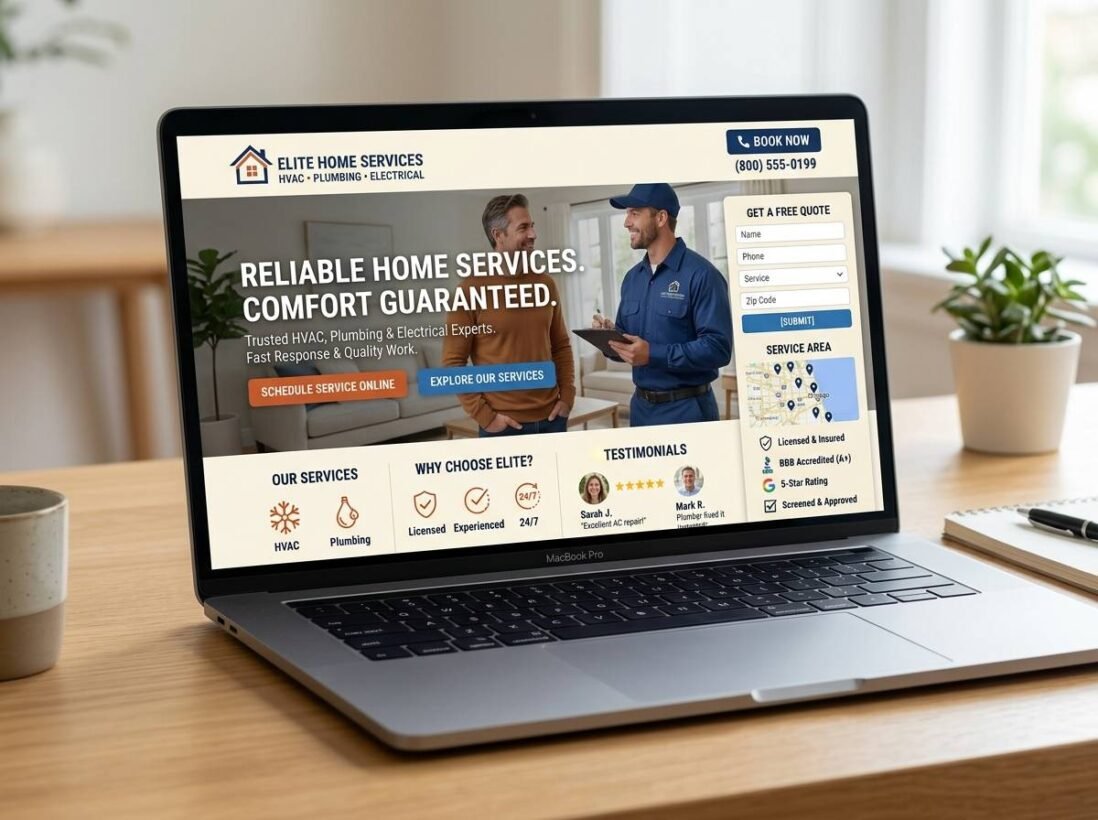
The digital storefront for any home services business in 2026 is its website. It’s no longer just a brochure; it’s a dynamic, high-converting tool designed to turn visitors into booked jobs. Our focus must be on creating a seamless, intuitive experience that builds trust and facilitates immediate action. A high-converting website prioritizes speed, mobile responsiveness, and clear calls-to-action, understanding that customers often search under duress and need quick solutions.
Conversion optimization is paramount. Every element, from the layout to the content, should guide the user towards booking a service or requesting a quote. Mobile-first design isn’t optional; it’s the standard, given that most local searches happen on smartphones. Website load speed directly impacts bounce rates and search engine rankings – anything over three seconds can lead to significant drop-offs. Trust signals, such as customer testimonials, licensing information, and service guarantees, must be prominently displayed. User experience (UX) should be frictionless, making it easy for potential customers to find what they need and take the next step.
For many home services businesses, leveraging low-code development platforms can significantly reduce the time and cost associated with building and maintaining a powerful online presence. These platforms, combined with intelligent optimization tools and niche-specific strategies like Digital marketing for garage doors, allow for rapid iteration and adaptation to changing market demands. Effective lead capture mechanisms, such as easy-to-fill forms and prominent phone numbers, are crucial. Additionally, dedicated service area pages, detailing the specific locations and services offered, enhance local relevance and search visibility.
Essential Website Elements for Conversion
To truly convert visitors, a home services website needs more than just a pretty face. It requires strategic integration of features that streamline the customer journey. Booking automation and self-service portals empower customers to schedule appointments at their convenience, a significant preference in today’s market. Live chat functionality provides immediate answers to urgent queries, preventing potential leads from bouncing. Secure hosting is non-negotiable for protecting customer data and maintaining site reliability.
Underpinning these elements is robust technical SEO, ensuring that search engines can easily crawl, index, and understand your site’s content. This includes structured data like schema markup, which helps search engines display rich snippets in results, making your listings more appealing. By focusing on these essential elements, we build a website that not only attracts visitors but actively converts them into valuable customers.
Content Strategies in Digital Marketing for Home Services
Beyond functionality, a website needs compelling content. For home services, content marketing isn’t about going viral; it’s about establishing authority, answering customer questions, and building trust. Educational blogs that address common homeowner problems (e.g., “Signs Your HVAC System Needs Repair,” “Preventative Plumbing Maintenance Tips”) position your business as a knowledgeable resource. Maintenance checklists offer tangible value, encouraging repeat visits and engagement.
Video testimonials featuring satisfied customers provide powerful social proof, often more impactful than written reviews alone. Comprehensive FAQ sections directly address customer concerns, reducing friction in the decision-making process. Developing topical authority around your core services through well-researched, in-depth content signals expertise to both customers and search engines. Furthermore, implementing semantic SEO strategies ensures that your content aligns with the broader context of user queries, capturing a wider range of relevant searches.
Dominating Local Search and Answer Engines
In the home services sector, “local” isn’t just a descriptor; it’s the cornerstone of lead generation. When a homeowner needs a repair, they’re typically looking for someone nearby, right now. This makes dominating local search results absolutely critical. In 2026, this extends beyond traditional Local SEO to include Answer Engine Optimization (AEO) and Generative Engine Optimization (GEO), as AI assistants and large language models increasingly mediate search experiences.
Our strategy must ensure consistent Name, Address, and Phone number (NAP) information across all online directories. Proximity ranking is a key factor in Google’s local algorithm, meaning businesses physically closer to the searcher often appear higher. Achieving AI search visibility requires a comprehensive approach, ensuring our business data is accessible and consistent across numerous platforms that AI models might draw from. Building local citations on relevant directories and creating neighborhood-specific content further reinforces our local presence. For specialized services like roofing, understanding the nuances of local weather patterns and specific building codes can be a game-changer, and resources like those focused on Digital marketing for roofers provide valuable insights into these localized strategies.
Optimizing Local SEO and Digital Marketing for Home Services
The goal of local SEO is to appear prominently in the “local 3-pack” and Google Maps results when potential customers search for services in our area. This involves meticulous optimization of our Google Business Profile (GBP), ensuring it’s fully completed and regularly updated. Strategic use of location keywords within our website content, service descriptions, and GBP posts helps us rank for queries like “plumber near me” or “HVAC repair [city name]”.
Implementing service-area schema markup on our website provides structured data to search engines, clarifying our operational zones. Geo-targeted landing pages, each tailored to a specific city or neighborhood we serve, can significantly boost our relevance for local searches. The continuous rise of “near me” search trends underscores the importance of these localized optimization efforts.
Managing Google Business Profile for Maximum Visibility
Our Google Business Profile is arguably the most powerful free marketing tool available. We must ensure 100% profile completeness, filling out every section with accurate, detailed information. High-quality photos of our team, trucks, and completed work build trust and showcase our professionalism. Regular, weekly updates – including posts about promotions, new services, or community involvement – keep the profile active and signal relevance to Google.
Seeding the Q&A section with common customer questions and providing helpful answers can preemptively address concerns and improve conversion rates. Enabling direct messaging allows customers to connect with us instantly, catering to their preference for quick communication. Finally, review recency plays a significant role; fresh, consistent reviews are crucial for both ranking and building consumer confidence.
High-Intent Lead Generation via Paid Channels
While organic strategies build long-term authority, paid channels offer immediate visibility and can generate high-intent leads quickly. In 2026, Google Local Services Ads (LSAs) and targeted PPC campaigns are indispensable for home services businesses looking to capture urgent demand.
Feature Google Local Services Ads (LSAs) Traditional PPC (Google Ads) Payment Model Pay-per-lead (you only pay when a customer contacts you) Pay-per-click (you pay every time someone clicks your ad) Placement Top of Google search results, often above standard PPC ads and organic Below LSAs, above organic results, or on display network Trust Signals Google Guaranteed badge, background checks, license verification Ad extensions (reviews, site links), ad copy Lead Quality Typically very high, as customers are ready to hire Varies; depends on keyword targeting and landing page optimization Control Limited control over ad copy, keywords; Google handles matching High control over keywords, ad copy, bidding, targeting, landing pages Setup/Management Simpler setup, less ongoing management once verified More complex setup, requires continuous optimization and monitoring Targeting Service-specific, geo-fenced to your service area Highly customizable: keywords, demographics, location, device, audience Reporting Lead volume, call recordings, customer reviews Clicks, impressions, conversions, cost, quality score, detailed analytics LSAs, in particular, have become a cornerstone for generating high-quality, ready-to-book leads. Search Engine Marketing (SEM), encompassing both LSAs and traditional PPC, allows us to strategically place our services in front of customers at their moment of need. This involves targeting high-intent keywords that indicate a customer is actively seeking a solution, structuring ad groups effectively, and implementing retargeting campaigns to re-engage previous website visitors. Maintaining a strong quality score for our ads helps reduce costs and improve placement. Additionally, careful use of negative keywords prevents our ads from showing for irrelevant searches, ensuring our budget is spent efficiently.
Leveraging Google Local Services Ads (LSAs)
Google Local Services Ads are uniquely effective for home services because they appear at the very top of search results, often above traditional paid ads and organic listings. The prominent Google Guaranteed badge provides an immediate layer of trust, assuring customers that Google stands behind our work. This program requires background checks and license verification, further bolstering consumer confidence.
The pay-per-lead model means we only pay when a customer contacts us directly through the LSA, whether by phone or message. This makes it a highly cost-effective channel for generating qualified leads. LSAs are designed for mobile click-to-call functionality, catering to the urgent, on-the-go nature of many home service searches. While Google handles much of the matching, understanding the ranking factors, such as review count, responsiveness, and proximity, allows us to optimize our LSA performance. A built-in lead dispute process also allows us to challenge leads that aren’t legitimate, protecting our ad spend.
Targeted PPC and Paid Advertising Tactics
Beyond LSAs, traditional PPC (Pay-Per-Click) through Google Ads and other platforms offers immense control and targeting capabilities. Geo-fencing allows us to target ads to specific geographic areas, ensuring we reach customers within our service radius. Crafting seasonal ad copy that reflects current needs (e.g., “AC Tune-Up Specials” in spring, “Furnace Repair” in winter) maximizes relevance.
Landing page relevance is crucial; ads should direct users to pages specifically designed to convert for that particular service. AI-powered bidding strategies can optimize our ad spend in real-time, automatically adjusting bids to achieve our desired cost-per-lead or conversion goals. YouTube pre-roll ads and targeted social media advertising (e.g., Facebook, Instagram) allow us to reach potential customers with visual content and build brand awareness, even before they have an immediate need.
Scaling with Automation and Reputation Management
In 2026, managing customer relationships and online reputation effectively is key to sustainable growth. Automation tools and a proactive approach to reviews can significantly enhance customer lifetime value and drive referral partnerships.
Reputation management is an ongoing process, not a one-time task. Implementing review automation systems, often integrated with CRM or field service management software, makes it easy to request feedback from customers immediately after service completion. SMS marketing can be highly effective for sending appointment reminders, follow-up messages, and review requests, given its high open rates. Email nurturing sequences can keep past customers engaged with seasonal reminders, special offers, and valuable content, fostering loyalty and driving repeat business.
Building a strong online presence also involves cultivating social proof through testimonials, project photos, and community engagement. Referral partnerships with complementary businesses (e.g., real estate agents, home inspectors) can be a consistent source of new leads. For businesses looking to optimize these processes with advanced tools, exploring solutions like Antares AI marketing for home services can provide a competitive edge, leveraging artificial intelligence to streamline and enhance various marketing functions.
The Role of Online Reviews and Trust
Online reviews are the new word-of-mouth. A staggering 93% of consumers read reviews before choosing a provider, and their recency matters as much as their volume. We must actively solicit reviews across multiple platforms (Google, Yelp, Angi, etc.) to ensure platform diversification and broad coverage. Sentiment analysis of reviews can provide invaluable insights into customer satisfaction and areas for improvement.
Responding to reviews, both positive and negative, quickly and thoughtfully demonstrates our commitment to customer service. Video reviews, where customers share their experiences directly, offer an authentic and highly persuasive form of social proof. The cumulative effect of a high star rating (ideally 4.5 or higher) and a consistent stream of fresh reviews significantly impacts both our search rankings and conversion rates. Additionally, using review schema markup on our website can help search engines display our star ratings directly in search results, boosting click-through rates.
Social Media and Email Automation for Retention
Social media for home services isn’t about going viral; it’s about building trust within local communities. Sharing before-and-after photos of projects on platforms like Instagram and Facebook showcases our work quality. Engaging in local Facebook community groups can establish our business as a helpful, trusted resource.
Email automation is an underutilized but high-ROI channel for home services. Segmenting our email lists by service history, equipment type, or last service date allows for highly targeted campaigns. Automated follow-ups after a service, seasonal reminders for maintenance (e.g., “Fall HVAC Check-up”), and promotions for service bundles (e.g., “Winter Plumbing & Heating Special”) keep our business top-of-mind. Newsletters can share valuable tips, company news, and special offers, fostering a sense of community and encouraging repeat business.
Measuring Success and Choosing the Right Partnership
Investing in digital marketing without measuring its impact is like driving blindfolded. To ensure our efforts are generating a positive Return on Investment (ROI), we must meticulously track Key Performance Indicators (KPIs) and make data-led decisions. This includes understanding our Cost Per Lead (CPL), call tracking, and integrating our marketing data with our CRM.
Effective measurement allows us to identify which channels are performing best, optimize underperforming campaigns, and allocate our budget strategically. The question of whether to handle digital marketing in-house or hire a specialized agency often arises. While in-house teams offer control, specialized agencies bring industry expertise, advanced tools, and scalability that can be difficult to replicate internally. Our goal is to achieve a sustainable lead flow, and the right partnership can be instrumental in achieving that.
Key Metrics and Tracking Tools
To truly understand our marketing performance, we need to go beyond surface-level metrics. Google Analytics 4 provides comprehensive website traffic and user behavior data. Google Search Console offers insights into our organic search performance, including keyword rankings and technical issues. Tracking our conversion rate (the percentage of visitors who complete a desired action, like booking a call) is fundamental.
The lead-to-close ratio helps us understand the effectiveness of our sales process, not just lead generation. Attribution modeling helps us understand which marketing touchpoints contribute to a conversion, allowing for more informed budget allocation. Tools like heatmaps can visualize user behavior on our website, identifying areas of friction or interest. By leveraging these tools, we gain a holistic view of our marketing ecosystem.
Selecting a Specialized Home Services Agency
Choosing the right digital marketing partner is a critical decision. We should look for agencies with proven industry experience in home services, as they understand the unique customer journey, seasonality, and urgent nature of our business. Reviewing their case studies and client testimonials provides insight into their past successes. Transparent reporting, outlining key metrics, progress, and challenges, is essential for building trust.
Strategic alignment is also crucial; the agency’s goals should mirror our own, focusing on booked jobs and revenue growth, not just vanity metrics like website traffic. Evaluating their technology stack and the tools they utilize can indicate their level of sophistication. Finally, clear and consistent communication protocols ensure we are always informed and involved in the marketing process.
Frequently Asked Questions about Digital Marketing for Home Services
Why is a 4-hour response window critical for home services?
In 2026, consumers expect immediate gratification, especially when facing a home emergency. Studies show that a significant percentage of customers make a hiring decision within a critical four-hour window of their initial search. If we don’t respond quickly, a competitor will. This immediate need creates a fierce competitive advantage for businesses that prioritize speed. Rapid response significantly increases conversion probability and prevents lead decay, as the customer’s urgency diminishes over time or they find another provider.
How does AI search change how contractors should approach SEO?
AI search, including Google AI Overviews and conversational AI assistants, represents a paradigm shift. Customers are increasingly using conversational queries, expecting direct answers rather than just a list of links. This means our SEO strategy must evolve beyond traditional keyword stuffing to Answer Engine Optimization (AEO) and Generative Engine Optimization (GEO). We need to provide clear, concise answers to common questions on our websites and GBP, optimize for structured data, and ensure our content is easily digestible by Large Language Models (LLMs). Informational intent becomes as important as transactional intent, as AI might recommend our business based on the helpfulness of our content.
What is the difference between LSAs and traditional Google Ads?
The primary difference lies in their payment structure, verification requirements, and placement. LSAs operate on a pay-per-lead model, meaning we only pay when a customer contacts us directly, whereas traditional Google Ads are pay-per-click. LSAs also come with a Google Guaranteed badge, requiring background checks and license verification, which builds immediate trust. They appear at the very top of search results, often above traditional PPC ads. While LSAs offer simpler management and high-quality leads, traditional Google Ads provide greater control over keywords, ad copy, and targeting, making them suitable for specific campaigns and broader reach.
Conclusion
The digital landscape of 2026 presents both challenges and unparalleled opportunities for home service contractors. To drive sustainable growth and achieve market leadership, we must embrace a strategic, multi-channel approach to digital marketing. By building a high-converting website, dominating local search and answer engines, leveraging high-intent paid channels, and scaling with automation and robust reputation management, we can secure a predictable flow of leads.
This comprehensive playbook provides the framework for future-proofing our businesses. The key is continuous adaptation, data-led decision-making, and a relentless focus on the customer journey. By investing wisely in digital marketing for home services, we can ensure our businesses not only survive but thrive in this dynamic digital era.