

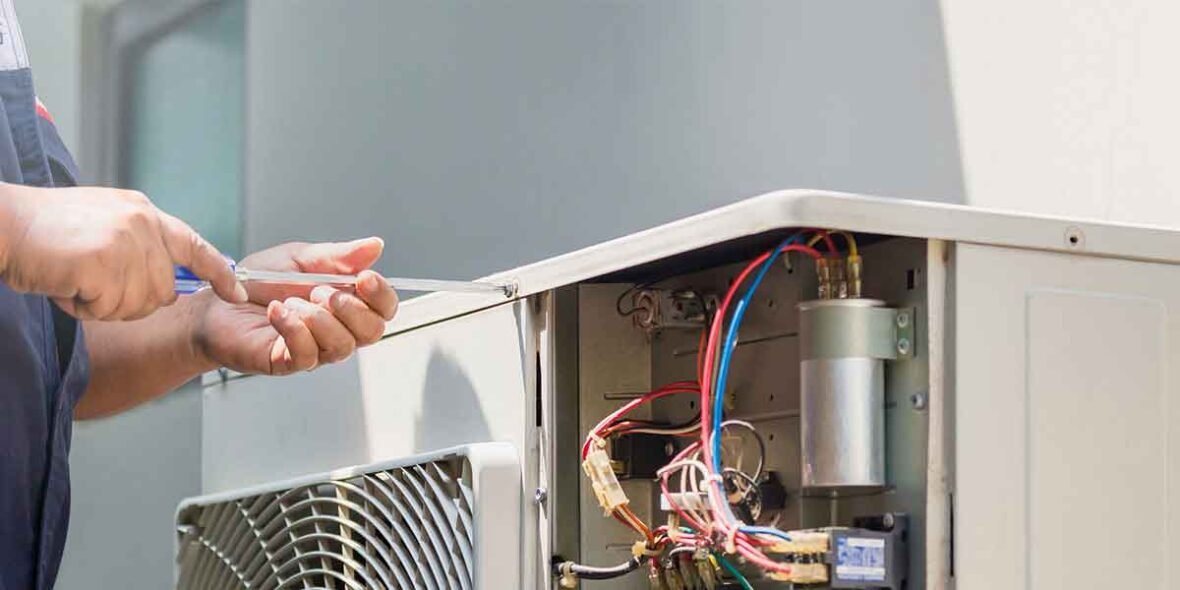
An ac repair cost calculator works on five auditable inputs: the diagnostic fee, the part, the labor hours at the local rate, the refrigerant when the sealed circuit is opened, and any access or permit costs. Most frequent repairs land between $200 and $900, and the full range runs from about $100 for a simple part to $5,000 or more for a compressor or coil. No single national price is universal, so the formula runs against your own quote: total = diagnostic fee + part + labor (hours x rate) + refrigerant + access and permits.
This covers central air conditioners in U.S. homes.
Car AC repair is a different system with different parts and labor, and it stays out of the math here.
A calculator that names the part, the test, and the hours is an audit tool. A quote that names only a total is a guess you are paying for, and the five lines below make the difference visible.
How the AC Repair Cost Calculator Works
The calculator is a five-input formula: total = diagnostic fee + part + labor (hours x local rate) + refrigerant if the sealed circuit is opened + access and permits. Run your quote through the five lines and the estimate either adds up or it does not.
| Cost input | Low | Typical | High | What moves it |
|---|---|---|---|---|
| Diagnostic fee | $75 | $100-$150 | $200+ | Often waived when you approve the repair at the same visit |
| Part | $75 | $100-$700 | $5,000+ | The component; capacitors are cheap, coils and compressors are the expensive rows |
| Labor | $100 | $200-$450 | $900+ | Hours at the local rate; access, age, and difficulty raise it |
| Refrigerant | $200 | $300 | $500+ | Type (R-22 costs more than R-410A) and how much the job needs |
| Access and permits | $0 | $50-$150 | $400+ | Attic or rooftop units, and municipalities that require a permit |
The observable symptom never sets the price; the diagnostic pass does. A humming unit with a failed capacitor is a $400 job, and the same humming unit with a failing compressor is a $2,500 job, and the technician only finds out which one it is by testing. That spread is normal, not a pricing error, which is why the diagnostic fee is the first line of the formula.
“Without knowing what was done nobody can tell you. This sounds like layers of broken telephone…its highly unlikely a “piece was missing””
– r/hvacadvice, July 2026 (17 upvotes)
The labor line is where the professional-versus-DIY split shows up first.
If you are doing the work yourself, the labor hours leave the formula, and the diy vs professional air conditioning installation guide lays out which parts of an HVAC job a homeowner can realistically own.
Repair Costs by Part: From Capacitor to Compressor
Repair cost by component follows a ladder: electrical parts under $700, fan motors and valves in the low hundreds, and sealed-circuit parts like compressors and coils from $900 up into the thousands. The most expensive repairs on any AC unit are the coil and the compressor.
| Failed part | Typical repair cost | Notes |
|---|---|---|
| Capacitor | $90-$475 | The frequent, low-cost fix; a $150 part plus labor |
| Circuit board | $75-$600 | Electronic diagnosis needed |
| Fan motor | $100-$700 | Condensing fan or blower; access matters |
| Thermostat | $90-$600 | Smart models cost more than basic ones |
| Expansion valve | $100-$700 | Refrigerant work involved |
| Condensate drain or pump | $100-$195 | Simple and frequent |
| Blower pipe | $400-$1,500 | Less common, mid-to-large job |
| Compressor | $900-$2,900 | The heart of the system; often the replace trigger |
| Condenser coil | $1,000-$4,000+ | Sealed-circuit replacement |
| Evaporator coil | $1,000-$5,000+ | Often starts the repair-versus-replace conversation |
Trane’s cost guide publishes the same per-part ladder, and the Trane air conditioner repair cost guide is the reference for the full table. The pattern to keep: most home repairs land in the $200-$900 band, and the expensive rows are where the replace conversation starts.
Regional Variables and the Low, Typical, and High Scenarios
Regional labor rates, heatwave demand, and local permits move the total, which is why the same capacitor job can price differently in two metros. The three worked scenarios below show how the formula behaves at the low, typical, and high end, using $150 an hour as a placeholder labor rate.
The labor rate is the biggest regional variable.
It changes by metro, by company size, and by season, and during a heatwave a busy shop can charge more for same-day service simply because of workload. Municipal permits add a separate line where local codes require one, and access to the unit, an attic install or a rooftop condenser, raises the hours.
Low scenario, a capacitor failure: diagnostic $100, part $150, one hour of labor at $150. Total near $400, which matches the capacitor row in the table above.
Typical scenario, a fan motor: diagnostic $100, part $300, two hours at $150. Total near $700.
High scenario, a compressor: diagnostic $100, part $1,500, four hours at $150 ($600), plus $300 of refrigerant. Total near $2,500.
Same formula, same house, six times the spread, and the difference is entirely in the part and the hours. The same repair can carry a meaningfully higher labor line in a high-cost metro, which is why state averages mislead as much as they help.
The replace conversation starts when the repair total approaches what the system is worth. A common industry rule of thumb runs it this way: multiply the system’s age in years by the repair cost, and when the product passes $5,000, replacement deserves a real conversation. One r/hvacadvice thread shows that math in the wild: a 10-year-old unit needed roughly $5,000 in repairs, and the replacement quote came in just shy of $14,000.
“The repair could be close to $5k because he would need a new capacitor, blower fan, and probably a new coil. he quoted just shy of $14k for a new system (keeping existing ducts) for a 14SEER2 3.5 ton unit with heat pump technology for a 2100sqft 1-story home in Dallas.”
– r/hvacadvice, March 2026 (4 upvotes)
What Keeps Repair Costs Down: Maintenance, Filters, and the DIY Line
Maintenance, clean filters, and a clear DIY line do not repair a failed part, but they reduce how often one fails and what the repair costs when it does. The sealed refrigerant circuit and the high-voltage wiring stay professional either way.
The maintenance side is mostly routine: washing the condenser coil, checking the drain, and verifying the charge during a seasonal visit.
Skipping it shows up as reduced airflow and higher head pressure, which ages parts faster, and the hvac maintenance checklist spells out what a routine pass actually covers.
Filters are the cheapest insurance in the formula. A clogged filter starves the blower, freezes the evaporator coil, and produces exactly the kind of repair call that a $20 filter change would have prevented, and the types of hvac filters guide covers which one your system takes. Matching the filter to the unit, not to the highest number on the shelf, matters more than most owners realize, and the best filters for indoor air quality guide works through that tradeoff.
Indoor air quality feeds the same loop: a dirty evaporator coil and a blocked drain are air-quality problems before they are repair bills, and the indoor air quality and health guide explains the health side of that connection.
The DIY line is fixed, not a budget choice. A homeowner can replace a capacitor or clean a coil, but opening the sealed refrigerant circuit requires EPA Section 608 certification, and the high-voltage hookup is licensed-electrician territory. Those are safety stop points, not upsells.
AC Repair Cost Calculator FAQ
What is the $5000 rule for AC?
The $5,000 rule is an industry rule of thumb: multiply the system’s age in years by the repair cost, and when the product passes $5,000, replacement deserves a serious conversation. A 10-year-old unit facing a $600 repair scores 6,000, which puts it in replace territory.
How much does it cost to replace an AC in a 2000 sq ft house?
A full central AC replacement for a 2,000 square foot home typically runs $8,000 to $15,000 or more depending on the region, the system size, and the brand. The range varies widely by metro, so treat it as a starting point and get three bids.
Is it worth fixing a 20 year old AC unit?
Usually not, unless the repair is small. A 20-year-old unit scores high on the age side of the $5,000 rule, replacement efficiencies are better, and the refrigerant in older systems can be expensive, so most pros steer toward replacement.
What is the most expensive repair on an AC unit?
The compressor and the evaporator coil are the two most expensive repairs, typically $900 to $5,000 or more including labor and refrigerant. Both are sealed-circuit parts, which is why they land at the top of the ladder.
Run the five inputs against the quote you hold, and the ac repair cost calculator either validates it or shows you which line to question. The wider Home Improvement guides on this site keep the related HVAC projects in one place.