

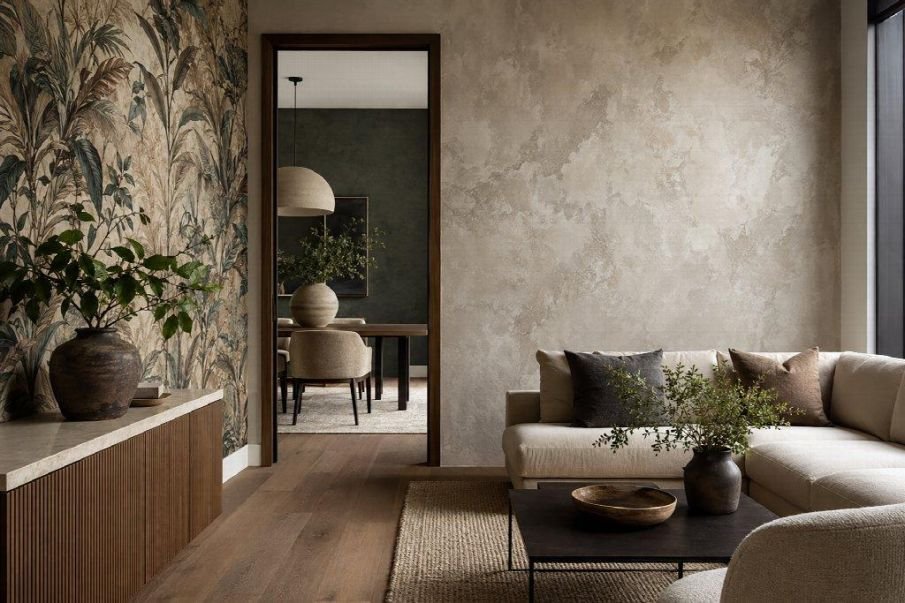
For years, walls were often treated as the quiet background of a room. Choose a neutral paint color, hang a few pieces of art, and move on to the furniture, lighting, and accessories.
That approach is changing.
More homeowners and designers are using the walls themselves as part of the architecture of a space. Patterned wallpaper can establish rhythm and personality, while textured plaster can introduce depth, movement, and subtle variations that change throughout the day. Used thoughtfully, these materials can make even a relatively simple room feel more considered and complete.
The key is not covering every surface with something dramatic. It is understanding what each wall contributes to the room and choosing a finish that supports that role.
Pattern Can Change How a Room Feels
Wallpaper does much more than introduce color. Scale, repetition, line, and contrast can all affect how we perceive a space.
A large botanical pattern can make a tall dining room feel more intimate. Vertical elements can emphasize ceiling height. Small repeating motifs may add detail without dominating a bedroom or powder room. Murals can visually expand a wall by creating a sense of landscape, depth, or perspective.
This is one reason wallpaper selection works best when it begins with the room rather than with a particular pattern.
Ceiling height, natural light, furniture placement, doors, windows, and architectural details all affect how the finished installation will look. A pattern that is impressive on a small sample may behave very differently when repeated across a 15-foot wall.
Material matters as well. Traditional paper, non-woven wallcoverings, vinyl, grasscloth, textile products, and murals each have different visual and practical characteristics.
For homeowners comparing designer wallpaper for sale, looking beyond color and pattern can make the selection process much easier. Sample size, roll dimensions, repeat, material type, room conditions, and installation requirements should all be considered before placing an order.
Texture Adds Depth Without Relying on Pattern
Not every room needs a visible motif.
Sometimes the most effective wall treatment is one that becomes interesting only when you get closer to it. Textured finishes create this effect through small variations in surface, sheen, and movement.
Depending on the material and application technique, a plastered wall can appear soft and cloudy, smooth and polished, mineral and matte, or deliberately rough and architectural.
Light plays an especially important role. A flat painted wall tends to respond uniformly to illumination. A textured surface behaves differently. Natural light moving across small ridges, trowel marks, and variations in the material can make the wall look different in the morning, afternoon, and evening.
That quality can add visual depth without introducing another strong color or graphic element into the room.
The Architecture Should Guide the Finish
A wall finish should not be selected in isolation from the architecture.
In a contemporary home with simple lines and large windows, a heavily ornamented treatment may compete with the structure. A restrained mineral finish or subtle wallpaper can provide enough variation while preserving the clean character of the space.
Traditional interiors offer different opportunities. Moldings, paneling, fireplaces, niches, and built-in cabinetry naturally divide walls into areas where pattern or texture can be introduced.
Even small architectural conditions matter. A wallpaper pattern crossing several corners may require careful layout decisions. A plaster finish extending around an archway or fireplace needs to work continuously across changing planes.
Before choosing the finish, it helps to ask a simple question: What is this wall supposed to do?
It may need to become a focal point, create a quieter background, emphasize an architectural feature, or visually connect several parts of the room.
The answer often determines whether pattern, texture, or a combination of materials makes the most sense.
Wallpaper and Plaster Can Work Together
Wallpaper and plaster do not have to compete.
In fact, some of the most balanced interiors use both.
A patterned wallcovering might define a dining room while a neighboring hallway uses a quieter mineral finish. A bedroom can combine wallpaper behind the headboard with softly textured walls elsewhere. In an open-plan home, changing wall materials can help distinguish functional areas without constructing physical partitions.
The important part is establishing hierarchy.
If the wallpaper has a large, colorful pattern, the surrounding plaster may work better with restrained movement and a related neutral tone. If the plaster is highly expressive, with strong texture or metallic effects, a quieter wallcovering can provide contrast without creating visual noise.
This relationship between pattern and texture is similar to combining fabrics, stone, wood, and other interior materials: they do not need to match, but they should feel intentional together.
Decorative Plaster Is More Than One Look
The term “plaster” can describe a surprisingly broad range of finishes.
Some applications create polished, stone-like surfaces. Others emphasize visible trowel movement or a soft, naturally varied appearance. Concrete-inspired finishes can work well in contemporary interiors, while lime-based materials can create a more organic character.
There are also finishes designed to resemble travertine or other mineral surfaces, as well as metallic treatments that interact strongly with artificial and natural light.
Because of this range, choosing among decorative plaster finishes should start with the desired visual effect rather than simply deciding that a room “needs plaster.” The substrate, lighting, surrounding materials, expected wear, and application technique can all influence the final result.
Samples are particularly valuable with these finishes because texture and sheen can be difficult to judge from a photograph alone.
Surface Preparation Is Part of the Design
One of the least visible parts of a finished wall is also one of the most important: the surface underneath it.
Wallpaper can reveal imperfections, especially with smooth or reflective materials. Seams, corners, patches, drywall texture, and uneven surfaces may become more noticeable after installation rather than disappearing.
Specialty plaster presents its own preparation requirements. The substrate needs to be appropriate for the selected system, and primers or base coats may be required before the decorative material is applied.
This is why wall preparation should be considered before materials are ordered.
If substantial skim coating, sanding, repairs, or priming will be necessary, those steps affect the project schedule and budget. They can also influence which finish is practical for a particular wall.
A beautiful material cannot compensate for an unsuitable substrate.
Think About Transitions Before Installation
Creative wall finishes rarely exist in isolation. Eventually, wallpaper or plaster has to meet something else: painted drywall, cabinetry, tile, stone, trim, a ceiling, or another decorative finish.
Those transitions deserve attention.
Where should wallpaper terminate around an open doorway? Should plaster continue around a corner or stop at an architectural break? How will the finish meet baseboards and crown molding? What happens behind floating shelves, televisions, sconces, or built-in cabinetry?
Resolving these questions early creates cleaner details and can prevent awkward changes during installation.
This becomes particularly important when multiple trades are involved. Designers, installers, painters, electricians, cabinetmakers, and trim carpenters may all interact with the same wall at different stages of the project.
Use Statement Walls Selectively
The popularity of feature walls sometimes creates pressure to make every room visually dramatic.
That is rarely necessary.
A strong wall treatment becomes more effective when the surrounding surfaces give it room to breathe. Instead of asking where another statement wall can be added, consider where the eye naturally lands when entering the room.
That may be the fireplace wall, the surface behind a bed, the end of a hallway, a dining-room wall, or even the ceiling.
Once that focal point is established, other surfaces can support it rather than compete with it.
In some spaces, the best decision may be no feature wall at all. A subtle wallcovering throughout the room or a continuous textured finish can create a stronger overall effect than one isolated decorative surface.
A More Material-Focused Approach to Walls
The growing interest in wallpaper and specialty finishes reflects a broader shift in interior design. Walls are increasingly being considered alongside flooring, cabinetry, stone, textiles, and lighting as materials that shape the character of a space.
That opens up far more possibilities than choosing between a few paint colors.
Pattern can introduce energy and narrative. Texture can add depth and respond to changing light. Natural and mineral surfaces can make a room feel tactile and grounded. Used together, these elements can establish hierarchy and help different spaces within a home feel connected without making them identical.
The most successful results usually come from restraint and planning. Start with the architecture, consider how the room is used, study the light, understand the material, and decide what role each wall should play.
When those decisions come first, wallpaper and decorative plaster stop feeling like surface decoration and become part of the design itself.