

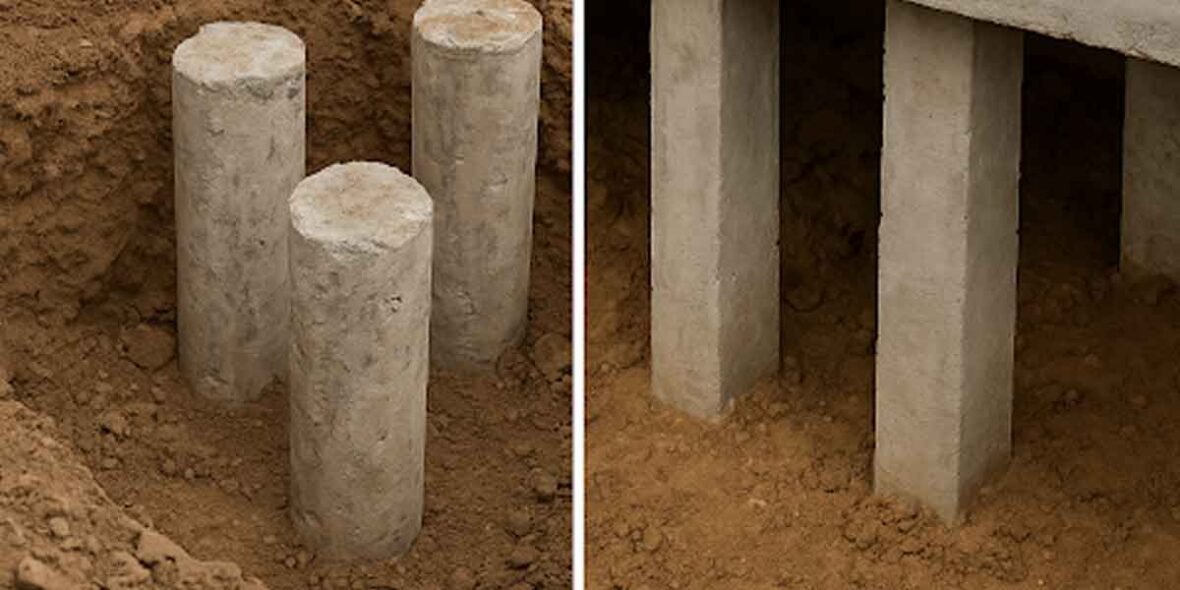
When soils near the surface cannot carry the loads a structure will deliver, the foundation has to reach deeper. For most projects, that decision comes down to two proven options: drilled shafts or driven piles. Both transfer loads to competent soil or rock. Both have a long track record on bridges, buildings, industrial facilities, and waterfront structures. They get there in very different ways, and those differences shape cost, schedule, risk, and neighbor relations.
This article walks through how each system works, where each tends to fit, and the questions worth answering before a deep foundation type is locked into the plans.
How the Two Systems Work
A drilled shaft is built by excavating a cylindrical hole to a design depth, placing a reinforcing cage, and filling the hole with concrete. The excavation may be kept open with temporary casing, drilling slurry, or in some cases the natural stability of the ground. Because the shaft is formed in place, its diameter and length can be tailored to the loads and the subsurface profile. Diameters commonly range from a few feet to well over ten feet, and shafts can be socketed into rock when the design calls for it.
Driven piles are manufactured elements, typically steel H-piles, steel pipe, precast concrete, or timber, that are pushed into the ground with an impact or vibratory hammer. Capacity develops through a combination of skin friction along the pile and end bearing at the tip. Because the soil is displaced rather than removed, driving can densify some granular soils and increase resistance as the pile advances.
The core distinction is simple. One system removes soil and builds the foundation in the hole. The other displaces soil and installs a prefabricated element.
Load Capacity and Structural Demand
Capacity is often the first filter. A single large-diameter shaft can carry column loads that would require a group of piles and a pile cap. For heavy bridge piers, tall buildings, and structures with significant lateral or overturning demand, one shaft under each column can simplify the foundation layout. It can also eliminate or reduce the pile cap, which saves excavation, formwork, and reinforcing.
Driven piles are efficient for moderate loads and are often installed in groups. Pile groups perform well when the design team wants redundancy, since the loss of one pile is shared by its neighbors. For lighter or repetitive loads, such as those in warehouse and low-rise work, the economy of a production pile-driving operation is hard to beat.
Lateral loading deserves its own attention. Wind, seismic forces, vessel impact, and soil pressure can control the design. Large-diameter shafts offer substantial stiffness against lateral movement. Piles can be battered or grouped to resist lateral forces, but the geometry adds complexity at the cap.
Subsurface Conditions Drive the Decision
No comparison means much without the geotechnical report. Soil and rock conditions often decide the question before cost enters the conversation.
Where shafts tend to fit:
- Sites with dense layers, cobbles, or shallow rock where driving would be difficult or would risk damage to the pile
- Projects requiring a rock socket to develop high capacity
- Profiles with variable depth to bearing, since the shaft length can be adjusted during construction
- Locations where vibration from driving is not acceptable
Where driven piles tend to fit:
- Loose to medium dense granular soils that benefit from displacement
- Deep soft deposits where a long, continuous element must reach a distant bearing layer
- Sites where open excavations are difficult to keep stable, such as clean sands below the water table
- Projects with a large number of identical, repetitive foundation locations
Obstructions cut both ways. Boulders and buried debris can stop a pile or deflect it off line. They can also slow a drilled shaft rig, though specialized tooling, such as core barrels and rock augers, is designed for those conditions. The key is knowing what is in the ground, which is why the quality of the subsurface investigation matters so much.
Vibration, Noise, and Neighboring Structures
Urban and developed sites change the math. Impact driving produces noise and ground vibration that can disturb occupants, affect sensitive equipment, and raise concerns about nearby buildings. Pile driving can sometimes be managed with pre-drilling, vibration monitoring, or alternative hammer types, but limits set by owners, municipalities, or adjacent property agreements may rule it out.
Drilled shafts generate far less vibration, which is a major reason they are often chosen near hospitals, laboratories, historic buildings, transit lines, and occupied properties. That does not make them risk free. Open excavations need careful control of ground loss, and slurry or casing methods must be managed to avoid disturbing nearby soils. A pre-construction survey and a monitoring plan are sound practice with either system.
Quality Control and Verification
The two systems verify capacity in different ways, and that affects both schedule and confidence.
Driven piles benefit from a visible installation record. Driving resistance, hammer energy, and final set provide real-time indicators of capacity, and dynamic testing can confirm performance on a sample of piles. Because piles are manufactured, their cross section is known before they reach the site.
Drilled shafts are concealed once the concrete is placed, so verification relies on process control and testing. Inspectors monitor excavation depth, bottom cleanliness, slurry properties, cage placement, and concrete volumes. After construction, integrity can be checked with methods such as crosshole sonic logging or thermal integrity profiling. Load tests, including large-scale tests, are used when the project warrants additional certainty. A well-run inspection program is essential, and the contractor’s experience with these methods carries real weight.
Schedule and Logistics
Production rate matters. A pile driving crew on open ground can install many piles in a day, and materials can be procured and staged ahead of time. Lead times for steel or precast elements need to be considered early, especially when markets are tight.
Drilled shafts typically take longer per foundation element, but each element carries more load, so fewer are needed. Mobilization involves larger rigs, concrete deliveries, and in many cases spoil handling and slurry management. Site access, laydown area, and haul routes should be checked before the schedule is set. Weather affects both systems, though concrete placement adds its own temperature and delivery considerations.
Cost Is More Than Unit Price
It is tempting to compare per-foot or per-unit pricing and stop there. A more useful comparison looks at the full foundation package:
- Number of elements and the size of pile caps or grade beams
- Excavation and backfill needed at the caps
- Testing and inspection requirements
- Risk of obstructions, refusal, or redesign
- Impact of vibration limits on the means and methods
- Schedule effects on following trades
A system with a higher unit cost can still produce a lower total cost if it reduces the number of elements, simplifies the cap, or avoids delays. The reverse is also true. Early pricing from experienced contractors can expose these tradeoffs before the design is fixed.
Bringing the Right People in Early
The strongest foundation decisions happen when the geotechnical engineer, structural engineer, general contractor, and specialty contractor compare options together. Constructability input changes designs for the better. A team that learns early that a site has cobble layers, tight access, or strict vibration limits can select a system that fits, rather than discovering the problem after bids are in.
Design-build delivery can help here, since the party that will build the foundation also helps shape it. Even on traditional projects, a preconstruction conversation with a qualified specialty contractor can clarify installation methods, testing plans, and realistic production rates.
A Practical Way to Decide
A simple sequence helps keep the process grounded:
- Review the geotechnical data for depth to bearing, groundwater, obstructions, and rock.
- Define the structural loads, including lateral and uplift demands.
- List site constraints such as vibration limits, access, and nearby structures.
- Compare the total installed foundation cost, not only the unit price.
- Evaluate verification and testing needs for each option.
- Confirm contractor experience with the selected system under similar conditions.
Final Thoughts
Neither option is better in every case. Drilled shafts and driven piles each solve real problems, and the right choice depends on loads, ground conditions, site constraints, and the schedule the project must meet. Teams that weigh these factors early, with input from the people who will build the work, avoid most of the surprises that make deep foundations costly. When the subsurface profile is complex or the site leaves little room for error, getting experienced specialty input before the foundation type is finalized is one of the most practical steps a project team can take.