

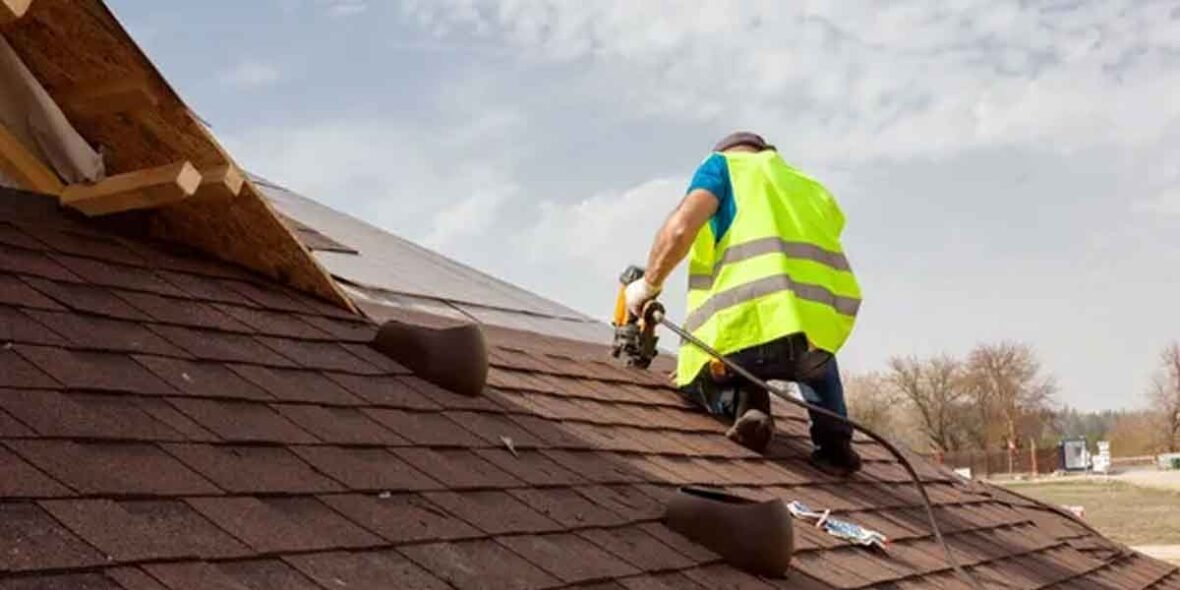
Commercial roofing problems rarely announce themselves dramatically. There is no loud moment when a roof begins to fail. It deteriorates gradually, often invisibly, until the damage that has been accumulating for months or years finally becomes visible from inside the building.
For commercial property owners and facility managers in Lake County, IL and across the greater Chicago area, where freeze-thaw cycling, heavy snowfall, and summer storm activity all stress roofing systems consistently, knowing the signs that warrant immediate professional assessment prevents the trajectory from deferred maintenance to expensive emergency repair.
1. Water Stains or Active Moisture Inside the Building
Interior water stains on ceilings or walls are the most visible symptom of roof failure, but they are almost never the beginning of the problem. By the time moisture appears inside a commercial building, the roof membrane has already been compromised at a specific location, water has been travelling laterally through the roof assembly for some time, and the insulation in the path of that water is saturated.
Saturated roof insulation does not dry out. It must be replaced. The longer it remains wet, the more surface area the moisture spreads into, expanding the scope of what needs to come out and be rebuilt.
A single water stain on a warehouse ceiling or office space does not mean the whole roof needs replacement. It means the entry point, the travel path, and the extent of saturation need to be assessed professionally before the scope of work can be determined. Waiting for a second stain to appear while monitoring the first is how a $4,000 patch repair becomes a $40,000 section replacement.
2. Standing Water That Remains More Than 48 Hours After Rain
Flat and low-slope commercial roofs are designed with a slope to drain. Standing water that remains on the surface more than 48 hours after precipitation indicates that drainage is not functioning as designed.
The causes are varied: blocked drains clogged with debris, insulation that has compressed and created low spots, membrane that has deflected under the weight of repeated water ponding, or improper original slope installation. Any of these can be progressive if not addressed.
Ponding water adds significant dead load to a roof structure. A 100-square-foot pool of water one inch deep weighs over 500 pounds. On a large commercial roof with multiple ponding areas, this load accumulates against a structure that was engineered for snow and dynamic loads, not permanent water weight. Over time, ponding accelerates membrane breakdown at the contact zone and creates conditions for biological growth that degrades the membrane further.
3. Roof Age Beyond the Expected Service Life
Most commercial flat roofing systems have documented expected service lives: TPO 20 to 30 years, EPDM 15 to 25 years, modified bitumen 15 to 20 years, built-up roofing 15 to 25 years. These figures assume proper installation and regular maintenance. Deferred maintenance, weather events, and thermal cycling compress them.
A roof that has reached or exceeded its expected service life is not necessarily failed. But it is in the phase where degradation is accelerating, where maintenance costs are increasing, and where the risk of a major weather event causing catastrophic water entry is highest.
An assessment at this stage is not about finding a reason to replace. It is about understanding the current condition accurately enough to make an informed decision about repair versus replacement and to plan the capital expenditure appropriately rather than reactively.
For commercial property owners and facility managers seeing any of these signs, getting a professional assessment from an experienced commercial roofing Lake County IL is the most cost-effective first step before the problem escalates.
Lakeland Exteriors & Roofing provides professional commercial roofing assessments across Lake County, Illinois, working with property owners to identify current conditions accurately and provide clear recommendations on repair or replacement scope.
4. Visible Membrane Blistering, Cracking, or Separation at Seams
Roof membrane condition is inspectable by trained eyes. For EPDM, modified bitumen, or TPO systems, there are specific visible failure modes that signal immediate assessment is warranted.
Blistering appears as raised, dome-like formations in the membrane surface. They form when moisture trapped in the adhesive layer or insulation vaporizes and pushes the membrane away from its substrate. Blisters that rupture create open membrane damage that allows direct water entry.
Cracking in TPO or modified bitumen membranes indicates UV degradation and thermal cycling fatigue. Once cracking begins, it accelerates with each weather event. A network of small cracks is not a monitoring situation. It is a repair or replacement planning situation.
Regular physical inspections help identify these membrane issues early before severe weather causes widespread damage. Property managers often rely on a qualified roofing company in Bellevue to evaluate structural wear, check for hidden seam gaps, and recommend routine maintenance that keeps commercial roofing systems durable over time.
Seam separation is among the most serious visible failures. Seams are the most stressed locations in any membrane system, and visible separation or lifting at a seam means the waterproof barrier at that joint is compromised or in the process of failing.
5. Increased Energy Bills Without a Clear Cause
A roofing system in good condition provides the thermal barrier that separates a conditioned interior from outdoor temperature extremes. When that barrier is compromised by moisture infiltration into the insulation, the insulating value of the roof assembly begins to deteriorate.
Wet insulation conducts heat rather than resisting it. For a commercial building spending thousands of dollars each month on heating and cooling, even a modest reduction in roofing performance can create a noticeable increase in operating costs over time.
According to the U.S. Department of Energy, insulation plays a critical role in reducing heat flow and improving overall energy efficiency. When roof insulation becomes wet or damaged, it can no longer perform as intended, forcing heating and cooling systems to work harder to maintain indoor temperatures.
If energy bills have increased without a corresponding change in occupancy, equipment usage, or utility rates, the roof system is one of the first building components worth investigating. Hidden moisture intrusion may already be affecting both the roof’s performance and the building’s operating expenses.
While maintaining the structural elements of a commercial building is vital for long-term value, property owners often balance these commercial updates with personal property upgrades. Planning ahead for home improvements, such as specialized remodeling services for bathrooms, helps ensure individual living spaces remain modern, functional, and efficient. Integrating these property updates systematically can improve daily comfort while supporting overall real estate value.
Conclusion
Commercial roof failures follow a predictable pattern: gradual deterioration, delayed detection, and rapid escalation in scope and cost once the damage becomes visible from inside the building. The five signs above are the points in that pattern where professional assessment can interrupt the trajectory. Acting on them early, rather than monitoring and waiting, is consistently the less expensive path.